How to read this: Labuan Bajo Honeymoon is an independent honeymoon planning & curation guide for Labuan Bajo and Komodo National Park (Flores, Indonesia) — we curate romantic stays and private phinisi sailings, then route your enquiry to a vetted partner (Komodo Luxury) who arranges the trip. We are not a resort, cruise operator or booking platform, and resort names are used only as neutral examples, not claims of affiliation or endorsement. Prices are by quote and vary by season, vessel and party; figures here are indicative ranges. Sea conditions, ferry and flight schedules, and park rules change — please verify with the operator and official Komodo National Park sources before you travel. This is general information, not advice or a binding offer. We may earn a referral fee at no extra cost to you, and it never changes what we publish.
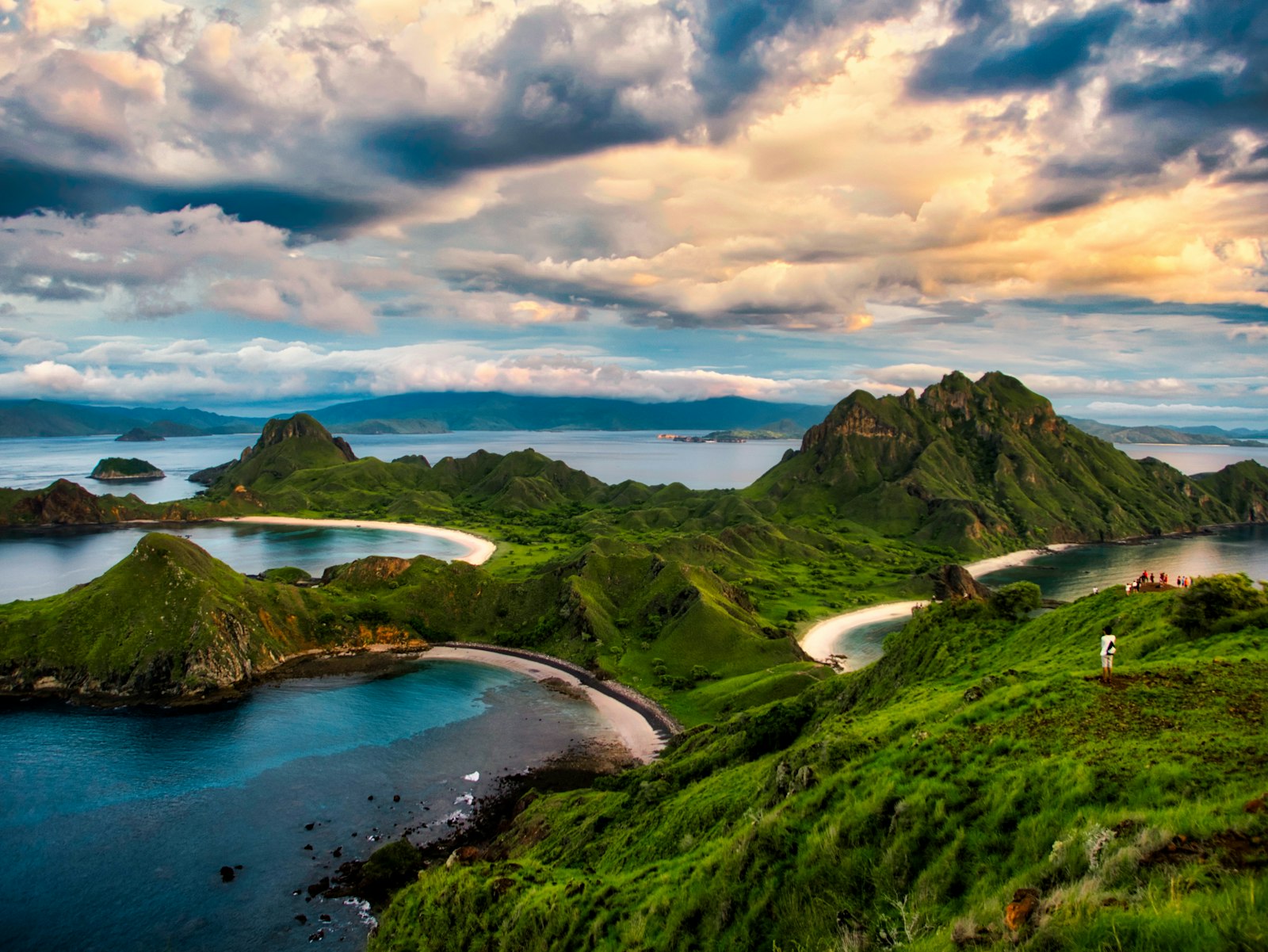
A Padar Island and Pink Beach honeymoon means standing at one of the most photographed viewpoints in Southeast Asia, then slipping into the water beside a beach that is genuinely, measurably pink — and doing both in a single day on a private boat out of Labuan Bajo. These two sites are the centrepiece of almost every Komodo National Park itinerary, and for good reason: Padar’s triple-bay panorama and Pink Beach’s blush-coloured shore are rare enough that people plan entire trips around them. What they are not, however, is effortless. This guide tells you exactly what to expect — the steep steps, the pre-dawn alarm call, the tidal caveats — so the day itself is a joy rather than a surprise.
Padar Island: What You’re Actually Climbing To
Padar Island sits inside Komodo National Park, accessible only by boat from Labuan Bajo. The island is famous for a single viewpoint: a ridgeline that reveals three bays simultaneously, each with sand of a different colour — dark volcanic sand on one side, white sand on another, and the deep coral-green of a protected cove on a third. The photograph from that ridge is one of the most reproduced images in Indonesian tourism. From the water, the island looks like a series of steep brown hills. From the top, the shape opens into something entirely different.
The path to the viewpoint is a man-made stepped trail. The climb takes most walkers roughly 20 to 40 minutes at a moderate pace, depending on fitness and how often you stop — and you will stop, because the views start well before the summit. The steps are steep in places. They are not technical; no ropes or equipment are needed. But they are relentless, and the equatorial sun is intense even at 06:00. Wear proper shoes with grip — sandals are a liability on the uneven stone. A hat and water bottle are non-negotiable.
The total number of steps is frequently cited in travel content as somewhere above 700. That figure is an estimate that circulates widely across operator websites and blog posts; there is no official park count, and no single authoritative source confirms it. What is confirmed: the climb is short but genuinely steep, and it earns you a view that justifies every step.
Why Sunrise Is the Operator Consensus for Couples
Virtually every tour operator selling the Padar island sunrise hike for couples departs Labuan Bajo at around 06:00 to 07:00, arriving at Padar in time for sunrise. This is operator consensus rather than a hard scientific prescription, but the logic is sound. At sunrise, the eastern bays catch the first light at a low angle — the kind of golden, directional light that makes every photograph look considered. The air is cooler by 5 to 8 degrees Celsius compared with midday. Crowds are smaller before the day-trip boats stack up at the jetty.
By 09:00 or 10:00, the sun is overhead and flat. The same view exists; the photograph is noticeably less dramatic. If your honeymoon photography matters to you — and given how many couples frame the Padar shot as the image of the trip, it probably does — the early alarm is worth setting.
On a private boat, you control the departure time. On a shared open-trip cruise, you go when the group goes. That distinction matters more at Padar than almost anywhere else in the park.
Photographing the Padar Viewpoint as a Couple
The classic shot is taken from the main upper platform, facing west so that both outer bays appear in the frame simultaneously. The light arrives from the east, meaning the bays are front-lit at sunrise — exactly right for two people standing at the edge. Bring a tripod or a lightweight gorilla-pod if you want clean couple shots without relying on other hikers. A wide-angle lens or a phone set to the widest setting captures all three bays; a tighter frame loses the right-hand cove.
Some couples book a private guide or a destination photographer to meet them at the base of the trail. If that is something you want, discuss it with your operator well in advance — Komodo National Park has rules about commercial activities on its islands, and a guide who knows those rules is the right person to coordinate this.
One practical note: the path narrows significantly near the top. If a group is descending while you ascend, you will be pressed against the hillside. Factor in ten extra minutes of buffer either side of the summit if you want uninterrupted time at the viewpoint.
Pink Beach: The Science Behind the Colour
Pink Beach — Pantai Merah in Indonesian, which translates simply as Red Beach — is located on Komodo Island, the larger island in the park that is also home to the Komodo dragon population. The name is slightly misleading in the way all beach colour names are: in strong midday light, the sand looks a warm peachy-rose. In overcast light, it reads closer to buff with a rosy undertone. At golden hour, it glows.
The colour comes from a specific and well-documented mechanism: the white sand is mixed with red and pink fragments of foraminifera, microscopic single-celled marine organisms with calcium carbonate shells. When foraminifera die, their shells break down and wash ashore alongside white coral fragments and standard quartz grains. The result is a blended sand that reads as pink. This is a scientifically accurate description of how the beach gets its colour; it is widely paraphrased across travel sources but is not, as far as we can confirm, formally documented in official Komodo National Park materials. The mechanism itself is legitimate coastal geomorphology, not marketing fiction.
There are reportedly a handful of pink-sand beaches in the park, though Pantai Merah on Komodo Island is the most visited and the one that operators mean when they say “Pink Beach.”
Pink Beach Komodo Snorkeling: What the Water Is Actually Like
The reef directly off Pink Beach is the main draw for honeymooners who want to snorkel Pink Beach Komodo together. The water is clear, typically calm in the bay, and the reef begins close to the shore — you do not need to swim far to find coral and fish. The diversity here is genuinely good: parrotfish, clownfish in their anemones, surgeonfish, and the occasional reef shark in the deeper water further out.
Current levels vary. Inside the bay, the water is usually gentle enough for confident swimmers. Further out toward the bay mouth, currents become less predictable. If either of you is a weaker swimmer, stay in the shallower section and let the fish come to you — they frequently do.
Reef-safe sunscreen is important here. Some operators require it; all should. Standard sunscreens containing oxybenzone and octinoxate contribute to coral bleaching. Bring your own zinc-based or mineral-formula sunscreen rather than assuming the boat stocks it. A rashguard is more practical than sunscreen alone for extended time in the water.
Wildlife sightings are real but never guaranteed. Turtles occasionally appear near Pink Beach. Manta rays are not reliably found here — Karang Makassar / Makassar Reef, a separate site between Komodo and Flores, is where manta encounters are more commonly arranged. Discuss your priorities with your operator when planning the day’s route.
Combining Padar and Pink Beach in One Day
Most operators route the two together: Padar at sunrise, then the boat continues to Pink Beach on Komodo Island for mid-morning snorkeling and beach time, often with a packed lunch onboard or a picnic setup on the sand. The combination works because the sites complement each other — one is a viewpoint, the other is a water experience — and because the boat journey between them, roughly an hour depending on vessel speed, gives you time to dry off, eat something, and decompress after the climb.
On a private charter, that interlude on the boat deck becomes part of the honeymoon. A crew who sets up cold towels, fresh fruit, and a quiet moment at the bow rail is doing something a shared trip cannot replicate. It is worth asking your operator specifically what the private boat experience includes between sites, not just at them.
- Padar Island hike duration
- Roughly 20–40 minutes to the viewpoint at a moderate pace; total round trip 60–90 minutes including time at the summit
- Step count
- Widely estimated at 700+ but unverified — no official park figure exists
- Best time at Padar
- Sunrise (operator consensus for light quality and cooler temperatures); boats typically depart Labuan Bajo around 06:00–07:00
- Pink Beach location
- Pantai Merah, Komodo Island, Komodo National Park
- Pink sand mechanism
- White quartz and coral mixed with red/pink foraminifera shell fragments — a scientifically documented process
- Snorkeling conditions
- Generally calm in the bay; currents increase toward the mouth; suitable for confident swimmers
- Park entry fees
- Bundled into most tour packages; most-cited foreign structure approximately IDR 250,000/person/day entry + IDR 100,000 conservation fee + IDR 25,000 harbour fee — confirm current rates with your operator before departure
- Footwear
- Closed-toe shoes with grip for the Padar hike; water shoes or sandals for Pink Beach
The Taka Makassar Sandbar: A Tide-Dependent Interlude
Between Padar and the larger islands lies a small sandbar called Taka Makassar — a crescent of white sand that appears above the waterline only at lower tides. On certain itineraries, operators anchor nearby and ferry couples across in a tender for a picnic or a wading session on the exposed sand. The images are arresting: a private sliver of sand surrounded by open sea, no other people, a boat riding at anchor in the distance.
The key phrase is tide-dependent. When the tide is high, Taka Makassar is submerged entirely or reduced to a thin strip that makes a picnic impractical. Whether it is accessible on a given day depends on the tidal chart, and operators who are honest about this will check before promising it as a fixed stop. Ask your operator directly: will Taka Makassar be accessible on our date, and what is the fallback if tides are unfavourable? A good operator will have an alternative — another calm bay, a different sandbar — rather than a vague reassurance. Park rules and conservation limits also apply to activities on sandbars within the national park boundary; your operator should know what is and is not permitted.
For couples who want the sandbar picnic, the experience is genuinely special when conditions align. Cold drinks, a spread of local food, and the sensation of standing in warm shallow water with no other humans visible is exactly the kind of moment that makes the Komodo honeymoon different from anywhere else. It is simply not something that can be guaranteed on a specific date without tide confirmation.
Plan this day with someone who knows the tides. A private boat itinerary that sequences Padar sunrise, Pink Beach snorkeling, and a Taka Makassar picnic — when tides allow — is one of the best single days available in the Komodo National Park. Our concierge partner can route it around the actual tide chart for your dates. Use our enquiry form or message us directly on WhatsApp at +62 811 3823 875 to start planning. No payment required to ask questions.
We publish independently. If you proceed with a partner we recommend, they may pay us a referral fee at no extra cost to you.
What Makes These Sites Romantic — and What Makes Them Hard Work
The honest version: Padar and Pink Beach are romantic because they are extraordinary, not because they are comfortable. The 04:30 wake-up is real. The climb is real. The equatorial sun at 08:00 is real. And yet the couples who do this consistently describe the Padar sunrise as one of the strongest memories of their honeymoon — not despite the effort but partly because of it. Arriving at the viewpoint together, breathing hard, and watching the sky change colour over three bays is a shared experience in a way that a poolside morning is not.
Pink Beach adds a different quality: it is slow and sensory. Floating in warm, clear water beside a pink shore, with no agenda except to drift and look at fish, is the decompression after the exertion. The two sites are naturally sequenced — exertion first, ease second — and that rhythm works well for couples.
What these sites are not: they are not private by default. Both are popular enough that other boats will be present, particularly between 09:00 and 14:00. A private charter lets you arrive earlier and leave before the crowd peak. A shared open trip means you share the beach and the viewpoint with strangers. Neither experience is bad; they are different, and the difference is worth understanding before you book.
Couples Photography: Light, Logistics and Expectations
For the Padar viewpoint for couples photography, the critical variable is arrival time. Before 07:00, the platform at the top has a handful of visitors. By 09:00, it is busy. By 10:00, it is crowded. The difference in photograph quality between those windows is significant — not just in light but in whether you can stand at the edge alone for two minutes.
At Pink Beach, photography is more relaxed. The beach is long enough that a couple can find space even when the bay is shared. The best light for beach portraits is early morning or late afternoon; at midday the light is flat and harsh. If your itinerary has you arriving at Pink Beach around 09:00 to 10:00, the light will still be reasonable. After 11:00, factor in shade and position your shots accordingly.
Drone photography requires a permit inside Komodo National Park. This is not a technicality that is usually waived — park rangers do enforce it. If aerial footage of the couple at Padar is a priority, check with your operator on the current permit process and timelines well before your trip.
Practical Guide: What to Bring and How to Prepare
Both sites reward preparation. The following list is practical rather than exhaustive — bring what you need, not everything that could theoretically be useful.
- Footwear: one pair of closed-toe shoes with grip (for Padar) and one pair of sandals or water shoes (for Pink Beach). Flip-flops alone are inadequate for the Padar trail.
- Sun protection: high-SPF mineral-formula sunscreen, a wide-brim hat, UV-protection rashguard or long-sleeve swimwear, polarized sunglasses. The equatorial UV index here regularly exceeds 11.
- Water: a minimum of one litre per person for the Padar hike. The climb is short but dehydrating. Most private boats carry water; confirm this with your operator.
- Camera gear: a waterproof case or dry bag for everything. Spray from the tender, humidity, and occasional rain can damage electronics quickly. Bring a microfibre cloth for lens cleaning.
- Snorkel equipment: most day-trip operators provide masks and fins, but the quality varies. If you own a comfortable mask, bring it — a mask that leaks makes snorkeling miserable regardless of what is in the water.
- Light layers: boat decks at 05:30 are surprisingly cool. A light jacket or long-sleeve layer for the early crossing is worth the minimal bag space.
Park Fees and Entry: What to Know Before You Go
Komodo National Park charges entry fees that are bundled into most tour and liveaboard packages. The most commonly reported structure for foreign visitors is approximately IDR 250,000 per person per day for entry, plus around IDR 100,000 conservation fee and IDR 25,000 harbour fee — but these figures circulate through operator and blog sources rather than a single official government tariff table in English, and the exact amounts and bundling change. Confirm the current structure with your operator before departure; ask specifically whether park fees are included in your package price or listed as an exclusion.
A note on a fee that is no longer current: in 2022 the park proposed a new annual membership fee of around IDR 3,750,000 per person (approximately USD 250 at the time). That proposal triggered significant protests from the local tourism industry and was subsequently suspended and then effectively cancelled. It is not in force in 2024 or 2025. Any source still listing it as current is out of date.
Combining These Sites with a Komodo Dragon Encounter
Komodo dragons are found on both Komodo Island (where Pink Beach is located) and Rinca Island. If your itinerary includes Pink Beach, adding a ranger-guided dragon trek on Komodo Island on the same day is logistically straightforward — the two sites are on the same island. Dragon sightings are likely during a guided walk but are never guaranteed; the animals are wild and move freely. A guided ranger walk is mandatory; approaching or attempting to interact with the animals independently is both prohibited and dangerous. The dragons are ambush predators and should be observed with the ranger present at all times.
Rinca Island is closer to Labuan Bajo and often paired with Kelor Island on a shorter half-day route, making it a good option for honeymooners who want the dragon experience without a full-day itinerary. The Rinca visitor area has a renovated boardwalk, which makes the trek somewhat more accessible for those who prefer a more defined path.
Seasonality: When to Plan Your Padar and Pink Beach Day
The dry season from roughly April to October gives the most reliable conditions for a Padar and Pink Beach day. May through September are the calmest months: seas are flatter, visibility in the water is better, and the risk of a rough crossing that turns a romantic morning into a seasickness emergency is lower. April and October are shoulder months — generally fine, with some variability.
The wet season, approximately November through March, brings rougher and less predictable seas. Komodo National Park does not close seasonally, but boat captains make judgement calls about whether crossings are safe. A specific day’s itinerary can be rescheduled or modified by weather. If you are honeymooning between November and March, build flexibility into your plans — have a second day as a buffer rather than trying to force the Padar sunrise on a single non-negotiable date.
In terms of crowds, the peak of domestic and international tourism in the park runs roughly June through August. Arriving early at Padar matters more during these months; the difference between 06:30 and 08:30 at the viewpoint is the difference between relative quiet and a queue on the steps.
Ready to plan? Sequencing Padar sunrise, Pink Beach snorkeling, a Taka Makassar picnic (tide allowing) and the rest of a Komodo honeymoon around the right tides and light conditions is exactly the kind of detail where an experienced concierge saves you from a disappointing day. Send us a message through our enquiry form or reach us on WhatsApp at +62 811 3823 875. We route to Komodo Luxury as our vetted concierge partner — they know these waters and can confirm Taka Makassar tidal access for your specific dates. No commitment required to ask.
Frequently Asked Questions
Is the Padar Island sunrise hike safe for couples with average fitness?
Yes, for most people with average fitness. The trail is steep and the steps are uneven in places, but it is a short climb — 20 to 40 minutes up for most walkers. Proper footwear with grip is important; flip-flops are not suitable. Start hydrating the night before and bring water for the hike. If either of you has a knee or joint issue that makes stair climbing difficult, be candid with your operator — there are other viewpoints in the park that require less elevation gain.
Why is Pink Beach actually pink, and will it look pink on a cloudy day?
The pink colour comes from foraminifera — microscopic marine organisms whose red and pink calcium carbonate shells mix into the white sand and coral fragments on the shore. The effect is real and permanent, not a trick of light. On a bright day, the sand reads as a clear peachy rose. On an overcast day, the colour is more muted — more warm buff than pink. Direct sunlight brings the colour out most vividly, which is another reason the mid-morning window between 08:00 and 11:00 tends to produce the best beach photographs here.
How do we arrange the Taka Makassar sandbar picnic, and is it guaranteed?
The sandbar is tide-dependent and cannot be guaranteed on any specific date. Request it explicitly when booking your private boat itinerary, and ask your operator to check the tidal chart for your dates. A good operator will either confirm it is feasible or suggest an alternative if tides are unfavourable. The picnic itself — food, drinks, setup on the sand — is typically arranged by your boat crew and may be included in private charter packages or available as an add-on. Confirm all inclusions in writing before you travel.
Can we do Padar Island and Pink Beach on a shared open-trip cruise?
Yes. Shared open-trip cruises regularly include both sites, and the price difference compared with a private charter is significant — budget open trips run from roughly IDR 2.75 million per person for a day trip, while private phinisi charters start from around USD 4,000 for a two-night arrangement. The trade-off is timing flexibility, privacy, and the ability to linger. On a shared trip, you go when the group goes and leave when the group leaves. At Padar especially, arriving at the viewpoint at a time that suits the light — rather than the group consensus — matters. If the sunrise shot is a priority, a private boat is the reliable way to get it.
Will we see turtles or manta rays snorkeling at Pink Beach?
No wildlife sighting in a marine national park is ever guaranteed. Reef fish are almost certain; turtles appear occasionally near Pink Beach and are a realistic possibility rather than a promise. Manta rays are not the main species at Pink Beach — for mantas, the dedicated site is Karang Makassar (Makassar Reef) between Komodo and Flores, where manta aggregations are more consistently reported, though even there sightings depend on season, current, and plankton levels. Tell your operator which experiences matter most to you so they can route the day to give you the best realistic chance at each one.