How to read this: Labuan Bajo Honeymoon is an independent honeymoon planning & curation guide for Labuan Bajo and Komodo National Park (Flores, Indonesia) — we curate romantic stays and private phinisi sailings, then route your enquiry to a vetted partner (Komodo Luxury) who arranges the trip. We are not a resort, cruise operator or booking platform, and resort names are used only as neutral examples, not claims of affiliation or endorsement. Prices are by quote and vary by season, vessel and party; figures here are indicative ranges. Sea conditions, ferry and flight schedules, and park rules change — please verify with the operator and official Komodo National Park sources before you travel. This is general information, not advice or a binding offer. We may earn a referral fee at no extra cost to you, and it never changes what we publish.
A 3-day Komodo honeymoon itinerary is a 3D2N journey from Labuan Bajo (Komodo Airport, LBJ) that packs the region's four headline experiences — the Padar Island sunrise hike, a Pink Beach snorkel, a manta-ray drift, and a Komodo or Rinca dragon walk — into roughly 48 active hours. It is the shortest trip that lets a couple feel the full range of the Komodo archipelago rather than just skimming one island. And it works, with an honest caveat: three days is tight, mornings start before most people would choose to be awake, and every single activity depends on sea conditions the ocean does not negotiate with anyone.
If slow romance is your definition of a honeymoon — lingering over breakfast, afternoon naps, not watching a clock — read the section below on pace before you commit. If you can handle an early alarm and genuinely want to see the park, this plan is a solid foundation. Use it as a template, not a contract.
Who This Itinerary Is (and Isn't) For
The 3D2N Komodo honeymoon is best matched to couples who are arriving from Bali as part of a longer two-center trip, who have limited leave from work, or who want to test the region before committing to a full week. First-time visitors to Komodo regularly say that three days felt exactly right for a sampler — and equally regularly say they wished they had four or five once they were actually out there.
This format is not ideal if either of you is prone to seasickness and has never been on a small traditional vessel. It is also a poor fit if you specifically want sunrise and sunset on Padar, extensive underwater photography time, or a languid private dinner on a sandbar at dusk. Those experiences exist in Komodo; they simply do not all fit cleanly inside 72 hours without the trip feeling like an itinerary rather than a honeymoon.
One more candid note: weather and sea conditions in the Komodo archipelago are real variables, not fine print. Crossings between islands involve tidal channels with strong currents. Operators will reschedule or reroute when the sea asks them to. Build a mental buffer for the possibility that Manta Point is skipped one morning because the current is running against a safe drift, and that Padar gets moved to the afternoon because swells are up. The best operators adjust without drama; the experience usually remains excellent even when the sequence changes.
Getting to Labuan Bajo: Arrival Day Logistics
Labuan Bajo is served by Komodo International Airport (IATA: LBJ), located at the western tip of Flores Island in East Nusa Tenggara. The airport sits roughly two kilometres from town — a five-to-fifteen minute transfer by taxi or resort shuttle, typically around IDR 50,000–70,000 by taxi (confirm the tariff on arrival; no official fixed rate).
From Bali (Ngurah Rai, DPS), the flight takes approximately one hour and ten to twenty minutes. Garuda Indonesia and Indonesia AirAsia are the two most established operators on this route; Citilink, Batik Air, Lion Air, Wings Air, and TransNusa have also served it at various points. Flight frequency varies significantly by season — roughly four to six departures each direction daily in low season, eight to ten or more during peak — so check schedules when you book, and book well ahead in July and August. Direct connections also exist from Jakarta (CGK) and Surabaya (SUB).
For a honeymoon, try to arrive by early afternoon. If your inbound flight is from Bali and departs before 10:00, you will typically reach Labuan Bajo by noon or shortly after, leaving time to settle into your resort or board your private phinisi and get oriented before the boat heads out at dawn the next day. Arriving on an evening flight means losing your first afternoon entirely, which on a 3D2N itinerary costs you real time.
What to do on Arrival Afternoon
Keep arrival day simple. Check into your resort or board your boat. Walk the LBJ waterfront at dusk — the marina strip is compact, easily walkable, and lined with local warungs and a few proper restaurants. If you are staying ashore, the sunset from any hilltop spot above the bay is genuinely good without requiring any effort. This is the right evening for a quiet dinner and an early night, because Day 2 starts before sunrise.
Day 1 (Full Day): Padar, Pink Beach, and Manta Point
Boats and day-trip operators typically leave the LBJ marina between 06:00 and 07:00 to reach Padar Island in time for sunrise. That means a 05:00–05:30 wakeup on a resort honeymoon, or simply rolling out of your cabin on a private boat as it anchors offshore. I will not pretend that 05:30 is romantic. But the Padar viewpoint at first light, with the bay colours shifting from grey to pink to amber and the silhouette of the adjacent islands sharpening below you, is one of the handful of views in Indonesia that actually earns its reputation.
Padar Island: The Sunrise Hike
The hike to the Padar viewpoint follows a series of man-made steps cut into the hillside. It is steep. A commonly repeated figure of “700+ steps” circulates online, but that count is unverified — what is accurate is that the climb takes most couples between 20 and 40 minutes at a moderate pace, and the path is exposed once you are above the tree line. Bring water, wear proper shoes (not sandals, not flip-flops), and go slowly in the heat.
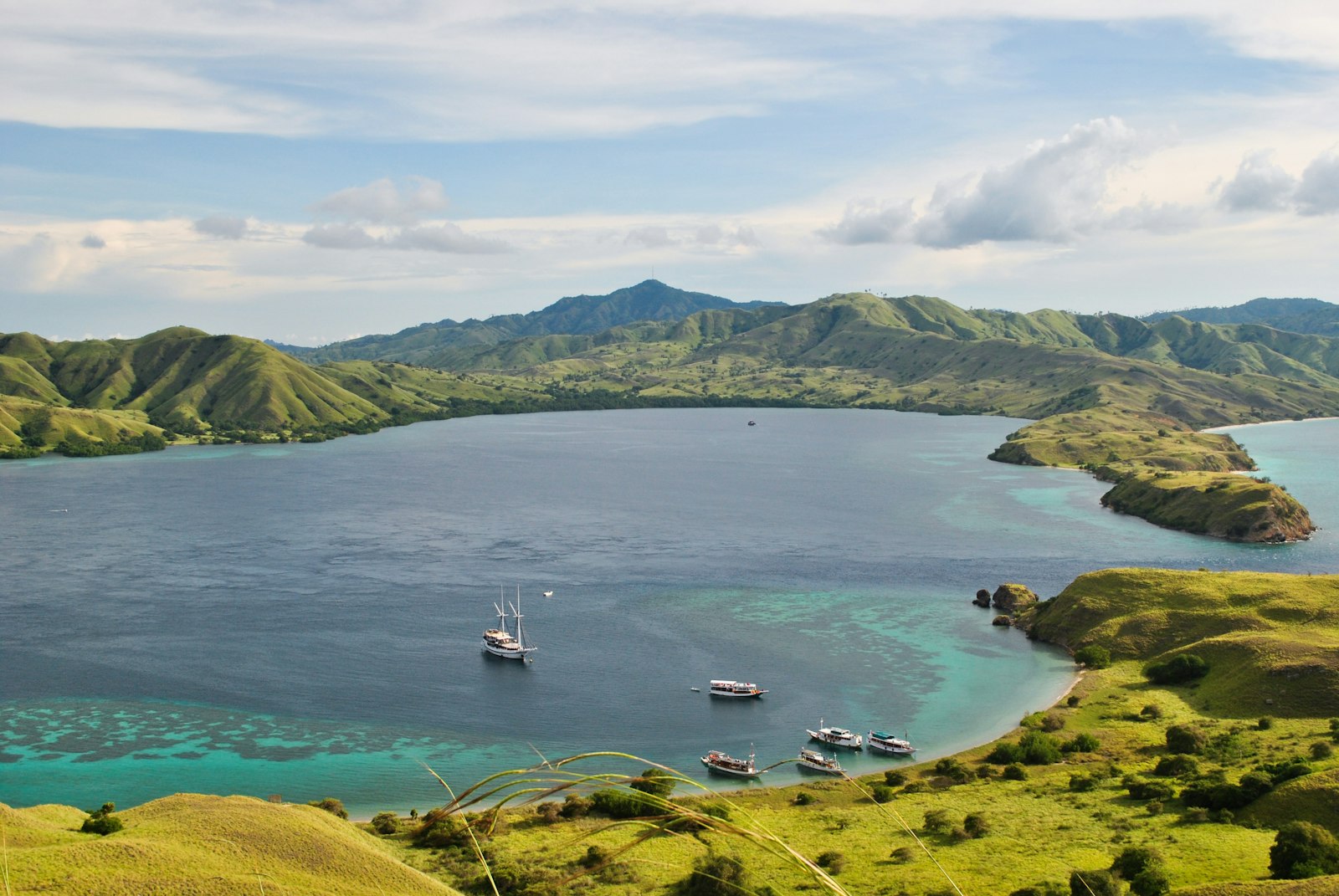
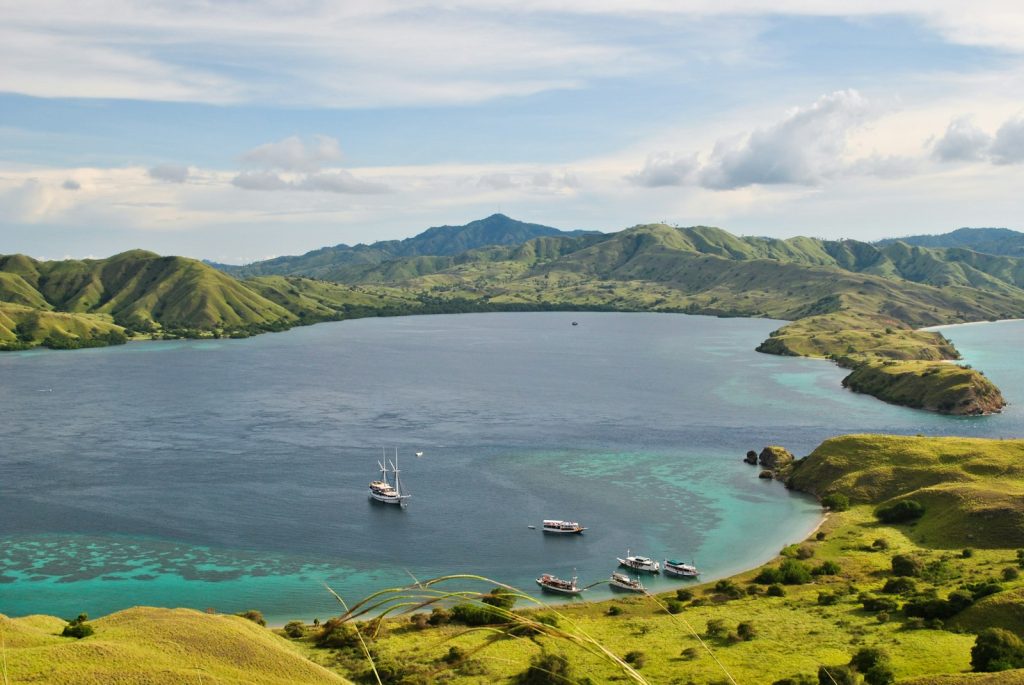
The view rewards you with three bays of different hues fanning out below the ridge: one bay tends toward dark blue-green, one to turquoise, one to lighter aqua. The pink-sand bay that gives Pink Beach its name is visible from the Padar ridge on a clear morning. Sunrise is the standard time for operators not because of sentimentality but because it is cooler, the light is better for photographs, and you beat the midday heat before the descent.
Padar is inside the Komodo National Park. Entry fees apply; see the fee note below.
Pink Beach (Pantai Merah): Snorkelling
After Padar, most itineraries head to Pink Beach on Komodo Island for snorkelling and a swim. The pink colour is genuine and it is not paint: the white sand is mixed with fragments of foraminifera, tiny calcified marine organisms whose red and pink shells break down and accumulate in the sand alongside coral bits over centuries. The effect is more subtle than the name implies — it reads as a pale rose-blush at midday and a warmer terracotta in early morning or late afternoon light.
Snorkelling here is good for beginners and confident swimmers alike. The reef is close to shore. Current can run through in places; stay near your guide and do not drift toward the point. If you bring your own reef-safe sunscreen, check that it is free of oxybenzone and octinoxate — some operators require this, and it is a reasonable thing to do regardless of rules.
Manta Point (Karang Makassar): Drift Snorkel
Manta Point, more precisely Karang Makassar or Makassar Reef, sits in the waters between Komodo Island and the Flores coastline. Manta rays gather here at a cleaning station, where smaller fish remove parasites, and they move through on feeding passes when plankton concentrations are right. The experience — when it works — is a drift snorkel with a strong current carrying you along the reef edge while one, two, or half a dozen mantas circle below you.
A frank note: manta sightings are never guaranteed. The mantas are wild animals responding to tidal and plankton conditions neither you nor your operator controls. Operators will tell you odds based on season and recent sightings, and those odds are generally good in the dry season, but “generally good” is not a promise. We have seen couples drift Karang Makassar on a flat-calm day and see eight mantas on one pass; we have also seen groups return without a single sighting after the same drift. Go with realistic expectations and the experience is usually excellent either way.
The current at Manta Point is strong and non-negotiable. Basic open-water swim confidence is necessary. A life jacket is not optional if your operator offers one and you have any doubt about your ability to hold position in current.
Evening: Komodo or Rinca Dragon Walk + Kalong Sunset
The afternoon slot on Day 1 is typically used for the Komodo dragon walk, either at Komodo Island or Rinca Island. The choice between them is worth understanding:
- Komodo Island
- Farther from LBJ (roughly two to three hours by boat each way from the marina, depending on vessel speed). Multiple trek lengths available, from a short loop to a longer trail through the interior. Dragons are numerous; Pink Beach is paired here on many itineraries. The island feels larger and wilder.
- Rinca Island
- Closer to LBJ (roughly one to one and a half hours). The visitor boardwalk area was renovated in recent years. Komodo dragons are reliably seen near the ranger station. Good option for couples who want the dragon experience without a very long boat crossing, or for those adding Rinca to an already full day.
At both islands, a guided ranger walk is mandatory. Komodo dragons are the world's largest lizard, apex predators, and genuinely dangerous. They do not perform for tourists; they ignore most visitors most of the time and then they do not. Stay behind your ranger, follow their instructions exactly, do not crouch or lower your camera to dragon eye-level without being told it is safe, and do not linger at any spot after your ranger signals to move. Sightings are likely but never guaranteed, and luring or feeding the animals is prohibited and destructive.
The Kalong sunset is a different kind of spectacle: thousands of flying foxes — large fruit bats with wingspans that can exceed a metre — lift off from the mangroves of Kalong Island at dusk in long dark rivers that pass across the orange sky. It is loud, strange, and wonderful. Many 3D2N itineraries include this as a late-afternoon anchor while the boat returns toward LBJ or a nearby mooring.
Day 2 (Half Day): Slow Morning, Departure
Day 2 in a 3D2N structure is your departure day. Most domestic flights out of LBJ toward Bali depart in the morning and early afternoon, which means you are likely leaving the resort or disembarking the boat by 08:00–09:00 to make a midday flight. Budget time for transfer, check-in, and the airport's modest size (it processes departures quickly, but security queues grow fast during peak hours).
If your outbound flight is an afternoon or evening departure — or if you have built an extra buffer night — use the morning for whatever you did not get to on Day 1. Kelor Island is a short trip from LBJ: a ten-to-twenty minute hike to a compact hilltop viewpoint with water views in every direction, plus shallow snorkelling off the beach. It is easy, undemanding, and a good slow-morning choice. Kanawa Island is another option, though its accommodation status has varied — confirm current access with your operator.
Some couples use the final morning simply to sit on the boat deck with coffee. That is not a waste. Sometimes the best memory from a boat trip is the one you did not plan.
Two Ways to Run the Itinerary: Resort vs. Private Cruise
A 3D2N Komodo honeymoon can be structured in two fundamentally different ways, and the right choice depends on what you value more: a fixed comfortable bed ashore, or uninterrupted privacy on the water.
Option A: Resort-Anchored with Day Trips
You stay at a property in or near Labuan Bajo — anything from a boutique guesthouse to a five-star beachfront resort — and join each day's excursion by boarding a day-trip vessel at the marina each morning. At the end of the day, you return to your room.
The advantages are real. You sleep in the same bed each night, hotel showers are more spacious than boat bathrooms, and if one of you is susceptible to seasickness you have a stable floor to come back to in the evening. Resort spa facilities exist at properties like AYANA Komodo (at Waecicu Beach, with a private boardwalk and jetty) and Ta'aktana, a Luxury Collection Resort & Spa (which opened in 2024 at Pantai Wae Rana). Romantic dinners, couples massages, and private candlelit-dinner setups are easier to arrange when a resort team is managing them.
The disadvantage is equally real: you share day-trip boats with strangers. On open-trip vessels — the cheaper, commonly booked option — a group of eight to twelve people is standard. There is nothing wrong with that for solo travellers or families. On a honeymoon, it means the sunrise on Padar is witnessed alongside a group of strangers, the drift at Manta Point is crowded, and there is no quiet moment on the water that is just yours.
A middle path: book a resort stay but charter a private day-trip boat for your group of two rather than joining a shared departure. Day-trip private charters are available from the LBJ marina and provide the flexibility of a private experience without requiring you to sleep on board. This costs more than a shared day trip but significantly less than a two-night private phinisi charter.
Option B: One- or Two-Night Private Phinisi Charter
A private phinisi is a traditional Indonesian two-masted wooden boat — often retrofitted with modern cabins, navigation electronics, solar power, and a proper galley — chartered exclusively for your party. On a honeymoon, that means the two of you, a crew, and the Komodo archipelago with no one else on board.
The experience is genuinely different. You anchor offshore at Pink Beach with the crowd gone, swim back to the boat, and have dinner on the open deck watching stars over Komodo Island. You wake up already at the islands. The flexibility to adjust the route based on weather, your mood, and what the ranger station recommends that morning belongs entirely to you.
The tradeoffs are also real. Cabins on even good private phinisi are compact; bathroom facilities are functional rather than luxurious; the boat moves in open water crossings, and if either of you gets seasick, you are at sea. Try to book an amidships cabin on larger vessels — the bow is the roughest point and the stern can be loud from engine vibration. Bring meclizine or dimenhydrinate, take it the evening before, and do not wait until you feel sick to start it.
For a 3D2N itinerary, a one-night private cruise (arriving in LBJ, boarding that evening, spending one night at sea, and disembarking the following evening before a final resort night) is sometimes offered. A two-night private charter covers the full arc more naturally: Day 1 afloat, Day 2 afloat, disembark on Day 3 morning for your flight.
Private phinisi charter rates vary considerably by vessel size, quality, and season. Based on current market ranges: a two-night private charter typically starts from around USD 4,000 for a couple in the mid-tier market, with premium and larger vessels ranging from USD 6,000 to USD 10,000 and above. All pricing is by quote; peak season (July–August) commands a premium. Ask for a line-item breakdown confirming whether park fees, ranger fees, and harbour fees are included — they frequently are not.
Komodo National Park Fees: What to Expect
Park fees at Komodo National Park are a consistent source of confusion, partly because they have changed several times and partly because operators bundle them differently. The fee structure most commonly reported for foreign visitors in 2024–2025 includes an entry ticket (approximately IDR 250,000 per person per day), a conservation fee (approximately IDR 100,000), and a harbour or administrative fee (approximately IDR 25,000 per person). A ranger or guide fee for the Komodo/Rinca dragon walks is typically additional, commonly cited around IDR 200,000 per group of up to five people.
Important context: the 2022 proposal to charge foreign visitors IDR 3,750,000 (roughly USD 250) each for an annual conservation membership was suspended after operator protests and a tourism strike in August 2022, and has since been effectively cancelled. It is not in force as of 2024–2025. If you see a source quoting that figure as current, it is outdated.
These fees are frequently bundled into tour or liveaboard packages without being itemised. Always ask your operator to confirm, in writing, exactly which fees are included and which are extra before you pay a deposit. The numbers above are the strongest figures reported from non-official sources; for the authoritative current rate, check with your operator or contact the Komodo National Park office directly. [VERIFY before publish]
Sample Schedule at a Glance
| Day | Time | Activity | Notes |
|---|---|---|---|
| Day 1 (Arrival) | Afternoon | Arrive LBJ, transfer to resort or board boat | Aim for morning flight from Bali for best timing |
| Day 1 | Dusk | LBJ waterfront walk, quiet dinner | Early night essential — 05:30 wakeup ahead |
| Day 2 (Full) | 05:30 | Wake up; boat departs by 06:00–07:00 | Resort couples board day-trip vessel at marina |
| Day 2 | ~07:30–09:00 | Padar Island sunrise hike (20–40 min ascent) | Steep steps; wear proper shoes; bring water |
| Day 2 | ~10:00–12:00 | Pink Beach snorkel and swim | Reef-safe sunscreen; current possible at point |
| Day 2 | ~12:00–13:00 | Lunch on boat or at beach | Private charters: boat galley; shared: packed box or beach warung |
| Day 2 | ~13:00–15:00 | Manta Point (Karang Makassar) drift snorkel | Sightings condition-dependent; not guaranteed |
| Day 2 | ~15:00–17:00 | Komodo or Rinca Island dragon walk (ranger mandatory) | Sightings likely but not guaranteed; follow ranger |
| Day 2 | ~17:30–18:30 | Kalong Island flying-fox sunset | Spectacle of thousands of flying foxes at dusk |
| Day 2 | Evening | Return to resort or anchor offshore | Private cruise: dinner on deck; resort: restaurant |
| Day 3 (Depart) | Morning | Optional: Kelor Island or slow boat morning | Skip if morning flight; build in departure buffer |
| Day 3 | By 09:00 | Transfer to LBJ airport for flight | Confirm flight time; LBJ airport is compact but can queue |
Best Time for a 3D2N Komodo Honeymoon
The dry season — roughly April through October, with May through September as the most reliable window — gives you the best conditions for a short trip. Seas are calmer, visibility is better underwater, and the risk of weather forcing a full reroute is lower. This matters especially on a 3D2N itinerary because you have almost no buffer days to absorb a disrupted plan.
The wet season (November through March) brings rougher and less predictable seas. Komodo National Park does not close seasonally, but crossing to Padar or running a drift at Manta Point when swells are running high is at the captain's discretion and may result in substitutions. For honeymooners on a short trip, that is a meaningful risk.
Peak season is July and August. Expect higher prices for both resorts and private charters, more visitors on the islands (though the park remains less crowded than, say, Bali's major temples), and the importance of booking well in advance for preferred vessels and properties. If you are flexible on dates, May, June, and September offer a good balance of weather reliability and slightly lower demand than the peak school-holiday months.
Manta ray encounters are reported year-round at Karang Makassar, but specific “best seasons” are asserted differently by different operators. Some cite December through February plankton blooms as productive manta months despite rougher seas; the data behind that claim is not robustly documented in public sources. [VERIFY with operator] The dry season consensus for overall trip quality holds regardless.
Honest Budget Ranges for a 3D2N Komodo Honeymoon
Numbers below are approximate ranges based on current market information. All are by-quote — actual pricing depends on vessel or property, season, group size, and inclusions. International flights to Bali are excluded.
- Budget approach (guesthouse + shared day trip)
- From roughly USD 150–250 per person per day for accommodation and day trips combined. Shared day-trip boats run from around IDR 2.75 million (approximately USD 175–200) per person for an open-trip liveaboard format. Not recommended as a honeymoon format due to shared vessel and limited privacy.
- Mid-range resort + private day-trip boat
- Resort accommodation at a mid-tier property in LBJ runs from approximately USD 100–300 per couple per night. Adding a private day-trip charter brings total daily spend to roughly USD 350–600 per couple. Good middle ground for couples who want privacy on the water but prefer a comfortable bed ashore.
- High-end resort + resort experiences
- Beachfront or five-star properties (AYANA Komodo, Ta'aktana, Plataran [VERIFY], Sudamala [VERIFY]) start from roughly USD 350–665+ per couple per night. Add spa sessions, private dinners, and private day-trip charters for a total daily range of approximately USD 500–800+.
- Private phinisi charter (all-in cruise)
- A two-night private charter for two people starts from around USD 4,000 in the mid-tier market and reaches USD 6,000–10,000+ for larger or premium vessels. This rate covers crew, meals, fuel, and usually fishing and snorkelling equipment. Park fees, ranger fees, and harbour fees are typically excluded — add approximately USD 80–150 per person depending on how many islands you visit.
None of these prices are fixed or guaranteed. Get itemised quotes from operators before committing. Ask specifically: Are park/ranger/harbour fees included? Is fuel included for the full itinerary? What meals are covered?
Ready to start comparing options? Use our enquiry form or reach out to our vetted planning partner on WhatsApp at +62 811 3823875 (Komodo Luxury, sales@komodoluxury.com) for a no-obligation itinerary discussion. No one can pay to change what we publish here; if you proceed with a partner through our free planning help, they may pay us a referral fee at no extra cost to you.
Should You Choose 3 Days or 5 Days?
This is the question I am asked most often by couples planning their first Komodo trip, and I want to give you a straight answer rather than a diplomatic hedge.
Three days works well if you are pairing Komodo with Bali (which the majority of honeymooners do) and your total trip is already ten or more days. It works well if your priority is a taste of the park and the dragon experience rather than deep underwater time. It works reasonably well if you are comfortable with a fast pace and genuinely enjoy the feeling of having squeezed a lot into a short window.
Three days falls short if you want lingering mornings, a second sunrise on Padar at your own pace, more than one manta encounter, diving rather than just snorkelling, or a candlelit private dinner on a remote sandbar that did not feel rushed. The five-day version gives you all of those things and still leaves a buffer for one weather disruption. If your honeymoon has the time, the five-day plan is almost always the more romantic choice.
The honest summary: a 3D2N Komodo honeymoon itinerary is excellent for what it is — a concentrated, intense encounter with one of the most remote and genuinely wild parts of Indonesia. It is not a relaxed honeymoon. It is an adventure honeymoon with a sunrise on a ridgeline, a manta below you in clear water, and a Komodo dragon crossing a ranger-cleared path fifteen metres away. If that is what you came for, three days is enough. If it is not, go for five.
Packing Essentials for a Short Komodo Honeymoon
The following is practical rather than comprehensive. For a 3D2N trip that includes boat time, snorkelling, hiking, and dragon walks:
- Footwear: closed-toe shoes with grip for the Padar hike and dragon walks (mandatory — sandals are not appropriate on either); water shoes or old trainers for boat boarding
- Sun protection: high-SPF reef-safe sunscreen (oxybenzone-free and octinoxate-free preferred), rashguard or UV-protective swim top, wide-brim hat, polarised sunglasses
- Seasickness: meclizine (Dramamine) or dimenhydrinate if either of you has any history of motion sickness; take it the evening before your first sea day, not the morning of
- Dry bags: one per person for phone, wallet, and anything electronic on the boat and during snorkel entries
- Hydration: refillable water bottle; most operators provide water but having your own reduces plastic waste
- Layers: boat decks can be cool at night and at dawn; a light long-sleeved layer and a windproof shell travel small and earn their weight
- Toiletries: reef-safe product choices matter more here than almost anywhere; the park has limited waste infrastructure
A note on health that is general information rather than medical advice: Flores is dengue-endemic and some areas of eastern Indonesia carry malaria risk. The waterfront town of Labuan Bajo is urbanised and coastal, but rural Flores and remote islands carry higher exposure risk. Consult a travel clinic or your GP before departure, ideally four to six weeks out, and check current guidance from CDC, UK Fit for Travel, or Smartraveller for your home country.
Planning Your 3D2N Komodo Honeymoon
The best time to start planning is three to six months before your intended travel date, especially if you are targeting May through September. Private phinisi charters in particular fill well in advance for peak season, and the better resort properties at Labuan Bajo do not have unlimited honeymoon-suite inventory.
We offer free planning consultations through our curation partner. Tell them your dates, whether you prefer a resort stay, a private cruise, or a hybrid, and any physical limitations or motion-sickness history — they will match you with the right format and handle the logistics. Start with our enquiry form or message directly on WhatsApp: +62 811 3823875.
Frequently Asked Questions
Is 3 days enough for a Komodo honeymoon?
Three days (3D2N) is enough to see Padar Island, Pink Beach, Manta Point, and the Komodo dragons — the four core experiences of the park. It is a fast, activity-focused format. Couples who want a slow, relaxed honeymoon with time to linger will likely find it rushed and are better suited to a five-day itinerary. For a first-time visit as part of a longer Bali–Komodo trip, three days is a solid and realistic choice.
What is the best way to see Komodo on a honeymoon: resort or private boat?
A private phinisi charter offers more romance and flexibility — you wake up at the islands, share the water with no one else, and have dinner under the stars. A resort stay with a private day-trip charter offers a more comfortable bed, easier spa access, and a stable base for anyone sensitive to boat motion. A mid-range resort plus a private day-trip boat (rather than a shared open-trip vessel) is often the best compromise for couples who want privacy without sleeping aboard.
Are manta ray sightings guaranteed on a 3D2N Komodo trip?
No. Manta encounters at Karang Makassar (Manta Point) depend on current, tidal conditions, plankton concentrations, and the mantas' own movement patterns. Sightings are common, especially in the dry season (May–October), but no honest operator will guarantee them. Manage expectations accordingly and the experience — drift snorkelling in crystal water over a cleaning reef — remains excellent even on days when manta sightings are brief or absent.
What are Komodo National Park entrance fees for foreign visitors?
The most commonly reported fee structure for foreign visitors in 2024–2025 includes an entry ticket of approximately IDR 250,000 per person per day, a conservation fee of approximately IDR 100,000, and a harbour or administrative fee of approximately IDR 25,000 per person. Ranger fees for dragon walks are additional. These fees are frequently bundled into tour packages without being itemised; always confirm with your operator what is and is not included. The 2022 proposal to charge IDR 3,750,000 as an annual conservation membership was cancelled and is not currently in force. Figures here should be confirmed directly with your operator or the Komodo National Park office, as fee structures can change. [VERIFY]
Can we see Komodo dragons on a 3D2N honeymoon itinerary?
Yes. A Komodo or Rinca dragon walk fits naturally into a full-day itinerary alongside Padar, Pink Beach, and Manta Point. Sightings are likely — Komodo dragons are numerous on both islands and tend to be active near the ranger stations — but are never guaranteed (no wildlife encounter can be). A guided ranger walk is mandatory at both islands; follow your ranger's instructions exactly. Rinca is closer to Labuan Bajo and works well when time or conditions make Komodo Island a longer round trip than ideal.