How to read this: Labuan Bajo Honeymoon is an independent honeymoon planning & curation guide for Labuan Bajo and Komodo National Park (Flores, Indonesia) — we curate romantic stays and private phinisi sailings, then route your enquiry to a vetted partner (Komodo Luxury) who arranges the trip. We are not a resort, cruise operator or booking platform, and resort names are used only as neutral examples, not claims of affiliation or endorsement. Prices are by quote and vary by season, vessel and party; figures here are indicative ranges. Sea conditions, ferry and flight schedules, and park rules change — please verify with the operator and official Komodo National Park sources before you travel. This is general information, not advice or a binding offer. We may earn a referral fee at no extra cost to you, and it never changes what we publish.
Couples diving Komodo on a honeymoon means sharing some of the richest reef topography in the world — giant manta rays at Karang Makassar, dense reef fish on Batu Bolong, thresher sharks at dawn in the right season — while also reckoning honestly with the fact that Komodo currents are among the strongest in Southeast Asia. That combination is what makes this area genuinely special, and genuinely unsuitable for everyone. This guide covers what the experience is really like for two people, together in the water, planning a once-in-a-lifetime trip.
Why Komodo Sits at the Top of Dive Travel Lists
The Komodo archipelago sits at the convergence of currents flowing between the Pacific and Indian Oceans, funnelled through narrow channels between Flores, Komodo Island, and Rinca. That upwelling of cold, nutrient-rich water feeds everything: the plankton that attract manta rays to Karang Makassar (often called Manta Point), the pelagic fish that patrol the blue water beyond Batu Bolong, and the hard coral gardens that have survived in places where the surge scrubs away the sediment that smothers reefs elsewhere.
For scuba diving komodo for couples, the payoff is undeniable when conditions line up. Watching a manta ray the size of a dining table do a lazy circle while your partner hovers a metre away — that is a genuinely shared moment that no beach dinner or spa treatment quite replicates. The site catalogue alone gives a honeymoon itinerary real texture: drift dives through towering pinnacles, coral gardens for gentle navigation dives, macro sites for photographers, and the famous Castle Rock and Crystal Rock sites in the north where the channel rips and the fish life stacks up in the current like a living wall.
The Current Question: Who Should Actually Dive Here
Here is where I will be direct, because most dive marketing glosses over this. Komodo is not a beginner-friendly dive destination. Some sites — shallow bays near Labuan Bajo, certain coral gardens on calm days — are manageable for recent Open Water graduates with a patient guide. But the marquee sites that put Komodo on every serious diver’s list run significant current, and the current is unpredictable. It can turn, accelerate unexpectedly, or stack through a channel in a way that pushes you off a wall at fifty metres a minute.
The practical standard most Komodo dive operators expect, though not all state explicitly, is around 20 logged dives with documented experience in mild-to-moderate current — the equivalent of an Advanced Open Water certification plus some real-water time. If one partner has that background and the other is a newly minted Open Water diver, you are looking at different dive programmes, not the same boat briefing.
Season matters too. The dry season, roughly May through September, brings calmer surface conditions and better visibility at most sites. Shoulder months of April and October are workable. Wet season (November through March) brings rougher seas, reduced visibility at some sites, and more frequent dive cancellations due to swell. Manta ray aggregation at Karang Makassar is reported year-round, with some operators citing December through February as a period of higher plankton density and larger aggregations — but that overlaps with rougher seas, and no sighting is ever guaranteed regardless of season.
Scuba Diving Komodo for Couples: The Shared Experience Question
One conversation every couple should have before booking: do you both dive, does one partner snorkel while the other dives, or does one partner want to learn? Each scenario works, but the logistics are different enough to affect which operator or vessel you should book.
Both Partners Are Divers
This is straightforward from a booking standpoint. Most day-trip dive boats run three dives daily, and liveaboards run three to four dives. The two of you are scheduled together, dive in the same group or with a guide who manages your experience as a pair, and surface to the same boat. The challenge is pacing — multiple days of three or four dives is physically demanding, and the nitrogen buildup over a liveaboard trip means your bodies will need rest days or shallow dives built into the itinerary. Good operators build this in. Less thorough ones will try to fill every slot.
Mixed: One Diver, One Snorkeller
This is more common than the dive industry likes to acknowledge, and Komodo handles it reasonably well because many sites have both a dive zone and a manageable snorkel zone. Manta Point at Karang Makassar is a drift snorkel as much as a dive site — the mantas cruise the shallows, and on calm days a confident swimmer on the surface can have an extraordinary encounter. Pink Beach on Komodo Island has shallow reef suitable for snorkelling. The honest caveat: the snorkel experience at the more current-heavy sites is different from the dive experience, and a non-diver will spend significant time on the boat during dives. Make sure the vessel has shade, comfortable seating, and ideally an attendant.
Learn to Dive Komodo Couple
The learn to dive komodo couple scenario is real and achievable, but requires deliberate planning. PADI and SSI Open Water courses run in Labuan Bajo over three to four days and include confined-water pool sessions, knowledge review, and four open-water checkout dives in the bay or at nearby shallow sites. Completing the course together before a liveaboard or park-based trip is actually a romantic project in itself — learning something new as a pair, then using that skill together in the national park. The realistic constraint: fresh Open Water graduates should not immediately attempt the stronger current sites. Build the itinerary so that your first days in the park are at appropriate sites — shallower reefs, gentle drift — before any guide even considers pointing you at Castle Rock.
Komodo Dive Sites Honeymoon Comparison
| Site | What to Expect | Current Level | Suitable for | Snorkel Option |
|---|---|---|---|---|
| Karang Makassar (Manta Point) | Manta cleaning station, open water, sightings not guaranteed | Moderate to strong, variable | AOW+ with current experience | Yes — drift snorkel, calm days |
| Batu Bolong | Pinnacle, dense reef fish, dramatic topography | Strong, site-dependent | Experienced divers | Not recommended |
| Castle Rock | Channel current, schooling fish, sharks, pelagics | Very strong, unpredictable | Advanced divers, calm conditions only | No |
| Crystal Rock | Pinnacle, good coral, mantas occasional | Moderate to strong | AOW+ recommended | No |
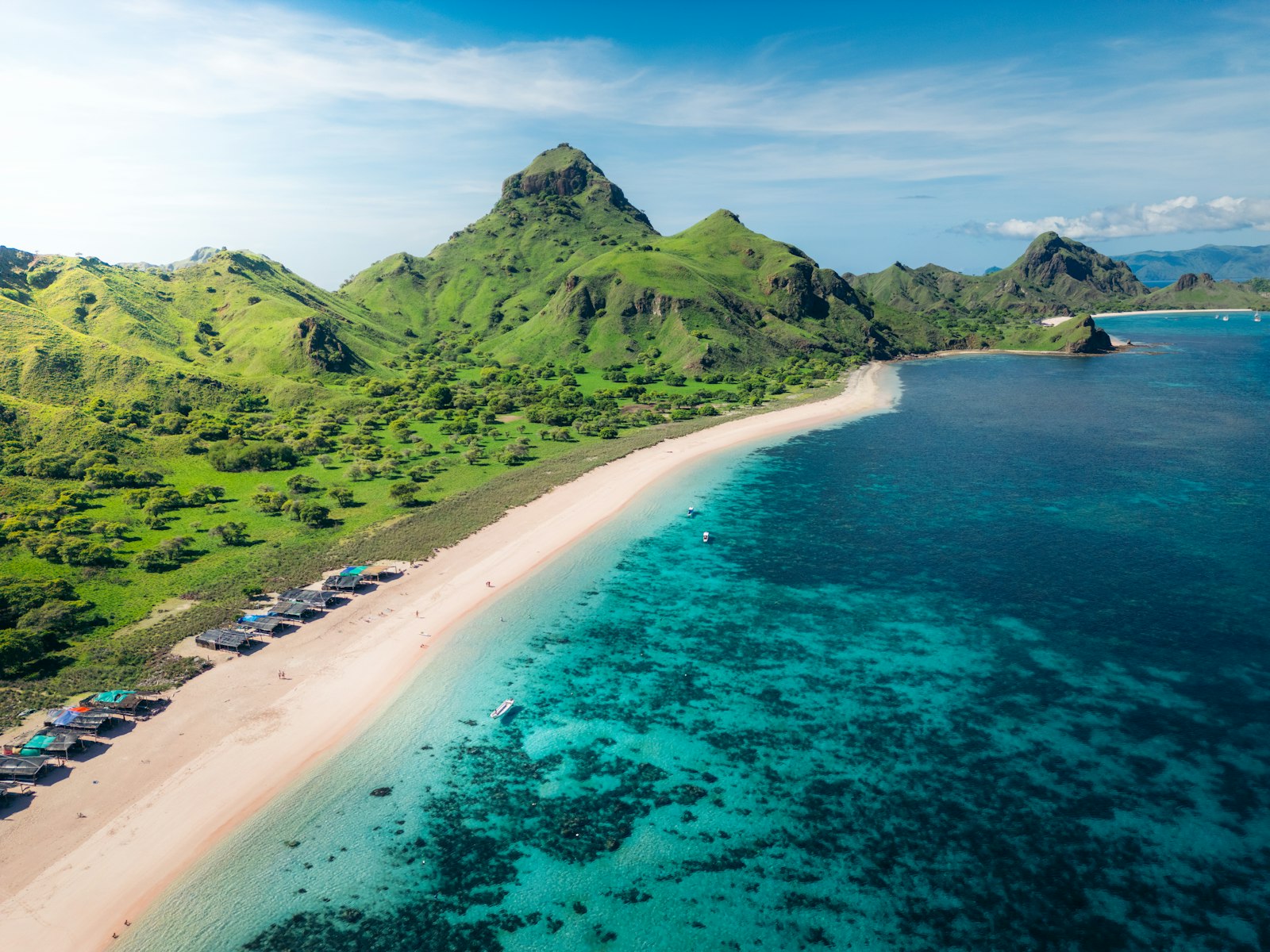
| Pink Beach reef (Komodo Island) | Shallow coral, calm bay, colourful fish | Mild | All levels, beginners welcome | Yes — good snorkel site |
| Tatawa Besar / Tatawa Kecil | Coral gardens, reef fish, turtles | Mild to moderate | Open Water comfortable | Possible on calm days |
Current intensity at any given site changes daily with tidal phase, season, and even time of day. The table above reflects typical conditions — your dive guide on the day will make the actual call on which site you enter and at what time.
Resort Diving vs Liveaboard: What Actually Fits a Honeymoon
Both formats work. The decision depends more on what the two of you want from the non-diving hours than from the diving itself.
Resort-Based Diving
You sleep in a proper hotel room or villa — actual beds, a bathroom that does not require standing on the toilet to get to the shower, privacy from other guests in the evenings. You join day-trip dive boats from the marina, typically departing around 06:00 to 07:00 and returning by early to mid-afternoon. Dining is at the resort or in Labuan Bajo town. The tradeoff is time: the best sites in the northern part of the park (Castle Rock, Crystal Rock) are a longer boat ride from Labuan Bajo, which eats into bottom time and makes for an early start.
Liveaboard
The liveaboard model puts you on the water, moving to sites overnight so you wake up ready to dive. Three to four dives per day is achievable without a two-hour commute. The sites you reach are better on average. The intimacy varies enormously: a shared open-trip liveaboard has eight to twelve passengers and bunk-style cabins. A private phinisi charter gives the two of you the entire boat. For a honeymoon, the shared-trip option is worth considering carefully — some couples enjoy the social dimension, many do not want strangers at breakfast every morning of their honeymoon week.
If diving is the centrepiece of the trip and you want both access to the best sites and genuine privacy, a private phinisi charter with a dive guide is the clean answer. It is also the most expensive format by some distance.
What Diving Costs: Honest Pricing Ranges
Prices in the Komodo dive market shift by season, operator quality, and what is bundled. The ranges below reflect what couples commonly encounter — treat them as orientation, not quotes, and verify current rates directly with any operator.
- Day-trip diving (from Labuan Bajo)
- Commonly around USD 160 per person per day for three dives, or around USD 200 per person per day for four dives, with equipment included. Park entry fees may or may not be bundled — confirm before booking.
- Shared liveaboard (open trip)
- From roughly USD 175–350 per person per day on a comfortable shared vessel, depending on the boat standard and itinerary length. A 2-night open trip for two people might total from USD 700–1,400 before park fees.
- Private phinisi charter
- The private route typically starts from around USD 4,000 for a 2-night charter (the whole boat, not per person), rising to USD 6,000–10,000 or more for 3–4 nights on a well-equipped vessel. Premium and larger phinisi can go higher. These figures are by-quote and peak-season pricing will be at the upper end of any range.
- Learn to Dive (Open Water course, Labuan Bajo)
- Varies by dive centre. Budget from around USD 350–500 per person for a full open-water certification course. Confirm what is included: pool session, gear, certification fee, park fees for open-water dives.
Komodo National Park entry fees are almost always listed as an exclusion from dive packages. The most commonly reported structure for foreign visitors is around IDR 250,000 per person per day plus a conservation fee of around IDR 100,000 and a harbour fee of approximately IDR 25,000, with a small additional diving surcharge — but these figures are not confirmed from an official government tariff table and should be verified with your operator or the park office before you travel. Fees are frequently bundled into liveaboard or day-trip packages; ask for the itemised breakdown.
If you want help structuring your diving itinerary and comparing what your budget will realistically cover, our enquiry form is a good starting point, or you can reach our planning concierge on WhatsApp at +62 811 3823 875. No one can pay to change what we publish; if you use our help and book through a partner operator, they may pay us a referral fee at no extra cost to you.
Safety: What Couples Should Know Before They Book
This is general information, not medical advice. Diving involves physiological risk, and the remoteness of the Komodo archipelago means that an emergency response here is not comparable to what you get diving off a Florida beach or in the Maldives.
Travel Insurance
Carry travel insurance that explicitly covers recreational scuba diving. Standard travel insurance often excludes it, and the cost difference for a policy that covers diving is small compared to the potential cost of a medical evacuation. Read the policy depth limits carefully — coverage sometimes excludes dives below 30 metres.
Decompression Facilities
Divers need to know where the nearest functioning decompression (hyperbaric) chamber is before entering the water. This is not optional planning. In the Komodo and Flores region, hyperbaric facilities have been referenced by some operators, but the operational status of any specific chamber is uncertain and must be verified directly with your dive shop or operator before you dive [VERIFY with operator before travel]. For serious decompression illness, evacuation to Bali or Jakarta is the standard protocol. That evacuation takes time. The combination of strong currents at many Komodo sites and the potential for rushed ascents — from current, from disorientation, from any number of situations — makes this an area where the decompression risk profile is higher than at many comparable destinations.
General Health and Fitness
Diving is physical. Days of multiple dives combined with boat travel, early starts, and sometimes rough crossings adds up. Both partners should have a recent fitness-to-dive medical if there is any doubt about health status. Discuss any medications with a dive-qualified physician before travel.
Seasickness
Komodo sea crossings can be choppy, particularly in channel passages and during the wetter months. If either of you is prone to motion sickness, bring effective medication (meclizine, dimenhydrinate, or patches — advice from your doctor on what suits you). On a liveaboard, cabins amidships near the waterline pitch less than bow or stern cabins on the upper deck. Do not be embarrassed to ask the operator about cabin position when booking. Seasickness affects a genuine proportion of guests on Komodo trips, and pretending otherwise does nobody a favour.
The Romance of It, Honestly
The experience of diving together — hovering neutrally buoyant in blue water while a manta glides underneath you, or holding a safety stop side by side at five metres watching a turtle drift past — is qualitatively different from experiencing it separately. There is a communication stripped down to hand signals and eye contact, a shared physical trust, that couples consistently describe as one of the more surprising aspects of taking up diving together. The debrief on the boat afterwards, replaying what you both saw, often goes on longer than the dive itself.
What Komodo adds to that is scale and wildness. The dragons on Komodo Island — which you will likely visit whether or not you dive, because the ranger walks are among the few ways to actually observe Varanus komodoensis in the wild — give the trip an otherworldly dimension that no beach destination quite matches. A honeymoon built around diving here tends to be remembered not for any single moment but for the cumulative strangeness and beauty of the place.
The practical suggestion I give couples: put your diving days in the middle of the trip, not the first day. Land first, rest, do an easy familiarisation dive or snorkel. Save the long-haul sites for when you know how you both feel on the boat, have found your rhythm with the guide, and are genuinely ready to focus on the experience rather than the logistics.
Planning Your Trip
Ready to work out the specifics — which sites fit your certification level, how many dive days to build in, whether a resort or a private phinisi charter makes more sense for your budget and priorities? Use our enquiry form or message our planning team on WhatsApp at +62 811 3823 875 (or email sales@komodoluxury.com). We will put together options without pressure.
Frequently Asked Questions
Is Komodo suitable for beginner divers on a honeymoon?
Some sites near Labuan Bajo and at sheltered bays within the national park are appropriate for Open Water-certified divers. The marquee current-dive sites (Batu Bolong, Castle Rock, Crystal Rock) are not — these are better suited to divers with around 20 or more logged dives and documented experience in current. If you or your partner are recent beginners, an itinerary mixing beginner-friendly reef dives with snorkel experiences at Manta Point and Pink Beach is a realistic and enjoyable approach, with the stronger sites saved for a future trip as your experience builds.
Can one partner dive while the other snorkels on the same trip?
Yes, and it is more common than many operators advertise. Several Komodo sites have both a dive zone and a sheltered snorkel area. Manta Point at Karang Makassar works particularly well for mixed pairs — the mantas cruise the shallows and a confident swimmer can have a remarkable encounter from the surface. Confirm with your operator in advance that the vessel accommodates non-divers comfortably, with shade and attention on the surface during dives.
What is the best time of year for scuba diving Komodo as a couple?
The dry season from approximately May through September offers the most consistent conditions — calmer seas, better underwater visibility at most sites, and fewer disrupted itineraries. April and October are reasonable shoulder months. The wet season (November through March) brings rougher crossings and reduced visibility at some sites, though manta ray sightings at Karang Makassar are reported year-round. If manta encounters are the priority, some operators point to December through February as a period of high plankton density, though this coincides with less comfortable surface conditions. Verify manta seasonality with your specific operator as it varies by site and year.
How much should we budget for diving on a Komodo honeymoon?
As a working guide: day-trip diving from Labuan Bajo commonly runs around USD 160 per person per day for three dives, or around USD 200 per day for four dives, with equipment. A private phinisi charter typically starts from around USD 4,000 for a 2-night booking for the whole boat, rising significantly for longer or premium itineraries. All prices are subject to seasonal variation and should be confirmed by quote. Park entry fees are usually separate — ask operators for the itemised breakdown. For a couple spending five nights combining resort accommodation with three dive days and one snorkel excursion, a realistic total budget (excluding international flights) runs from approximately USD 2,500 upward, with luxury liveaboard or private charter formats substantially higher.
Is there a decompression chamber near Komodo for dive emergencies?
This is one of the most important questions to ask your dive operator before booking, and the answer must come from them directly rather than from any guide — including this one. The operational status of hyperbaric facilities near Flores and the Komodo region is uncertain and changes over time [VERIFY with your dive shop]. Serious decompression illness cases are typically evacuated to Bali or Jakarta, which takes time. Divers should carry travel insurance that covers recreational diving and evacuation, confirm the nearest functioning chamber location and evacuation protocol with their operator prior to the first dive, and dive conservatively — following ascent rates, safety stops, and conservative depth profiles — in a region where the current profile increases the statistical likelihood of rushed ascents.