How to read this: Labuan Bajo Honeymoon is an independent honeymoon planning & curation guide for Labuan Bajo and Komodo National Park (Flores, Indonesia) — we curate romantic stays and private phinisi sailings, then route your enquiry to a vetted partner (Komodo Luxury) who arranges the trip. We are not a resort, cruise operator or booking platform, and resort names are used only as neutral examples, not claims of affiliation or endorsement. Prices are by quote and vary by season, vessel and party; figures here are indicative ranges. Sea conditions, ferry and flight schedules, and park rules change — please verify with the operator and official Komodo National Park sources before you travel. This is general information, not advice or a binding offer. We may earn a referral fee at no extra cost to you, and it never changes what we publish.
A 7-day Bali and Komodo honeymoon itinerary splits roughly three to four nights in Bali followed by three to four nights in Labuan Bajo — the gateway to Komodo National Park — connected by a single short hop of about one hour and ten to twenty minutes on a direct flight from Denpasar (DPS) to Komodo International Airport (LBJ). This two-center pattern is by far the most common one-week structure for couples because Bali handles the easy landing: international connections, spas, good restaurants, and any administrative catch-up after the wedding. Komodo handles the adventure: Padar Island sunrises, Pink Beach snorkeling, Komodo dragons on Rinca, and the quiet sensation of watching the lights of Labuan Bajo disappear behind your stern as a phinisi sails you into the archipelago.
Below is a day-by-day sketch of how that week actually flows, including where the timing traps are, what the accommodation choices mean for your budget and energy levels, and what you cannot know in advance because no one can.
Day 1–3: Bali — Land, Recover, Explore
Most couples arrive in Bali on an international long-haul. The first day is a near-total write-off for most people: customs, transfer to wherever you are staying, and the realization that the wedding is finished and you can finally sit still. Plan nothing on Day 1 except dinner.
Day 2 is where Bali does its best work for honeymooners. The spa infrastructure in Ubud and Seminyak ranges from small family-run spaces charging IDR 200,000 for an hour-long massage to resort treatment suites with four-hand sequences and floral baths. A full spa morning followed by a private cooking class or a late afternoon at a rice-terrace café covers Day 2 without any driving stress.
Day 3 is best saved for anything your trip still needs: a run to change money, a short temple visit, or, if this is your post-wedding trip, any loose document-related errands. The practical point is that Bali has banks, pharmacies, international SIMs, and a clinic on every corner. Labuan Bajo has far fewer of those things. Stock up here.
Where to stay in Bali for this trip
For a one-week Bali and Komodo two-center honeymoon, the location of your Bali base matters less than in a longer Bali-only trip, because you are not trying to see everything — you are resting and transiting. Seminyak and Canggu have the best private-pool villa inventory at a range of budgets and are thirty to forty minutes from the airport. Ubud puts you further inland with rice-field views and the best spa culture. Either works; the trade-off is traffic. Ubud can be an hour from DPS in peak traffic, and your Day 4 departure for Komodo will likely require a 05:30–06:00 airport run. Choose accordingly.
Day 4: The Flight to Labuan Bajo
This is the hinge day of the whole trip and the one that causes the most avoidable frustration.
The DPS–LBJ route has roughly four to six departures per day in low season and eight to ten in high season [based on a single resort blog source — confirm direct with your airline before booking]. Airlines that have operated the route include Garuda Indonesia, Indonesia AirAsia, Citilink, Batik Air, Lion Air, Wings Air, and TransNusa. The mix and frequencies change by date, so always verify your exact schedule at the time of booking [VERIFY]. What is consistent is the block time: about one hour ten to twenty minutes in the air, meaning a morning departure gets you to Labuan Bajo by mid-morning local time.
Why your flight timing on Day 4 matters more than it sounds
If you are joining a private phinisi charter, your boat typically embarks in the afternoon of the day you arrive. A midday flight from Bali that runs one hour late costs you nothing except a hurried lunch. A morning flight that gets delayed until the afternoon can compress your embarkation window or, on a rare bad day, push it to the next morning. Since most private charters run for two or three nights and every sunrise anchorage counts, losing even four hours at the start stings.
The buffer strategy: book the earliest DPS departure your body can manage. A 06:30 departure from Denpasar lands you in Labuan Bajo by 08:00–08:30 local. Even with a ninety-minute delay you are still dockside by noon. Alternatively, fly Day 3 in the afternoon and spend Night 3 in Labuan Bajo itself — you lose a Bali night but you gain a morning calm-water departure on Day 4 with no flight nerves.
Airport arrival and transfer
Komodo International Airport sits roughly two kilometers from the town center — about five to fifteen minutes by taxi or private transfer. The meter-free taxis around LBJ run approximately IDR 50,000–70,000 into town (non-official local rate — confirm on arrival). If you are heading directly to a resort or marina for embarkation, arrange pickup in advance; resort transfers are routine here.
Day 4 Afternoon – Day 7: Komodo — the Heart of the Itinerary
Three nights in the Komodo archipelago is the most common duration for this one-week Bali Labuan Bajo honeymoon pattern, and it is enough to hit the headline sites without turning the trip into a logistics exercise. Four nights is better if budget allows — the extra night usually means one more quiet anchorage and less rushing at Rinca or Padar.
What you do with those three to four nights depends almost entirely on one decision: resort, private phinisi, or a hybrid of both.
Resort vs Private Phinisi: A Candid Comparison
This question comes up in almost every planning conversation, and the honest answer is that neither option is universally better. They suit different couples.
| Factor | Land Resort | Private Phinisi Charter |
|---|---|---|
| Privacy | Your villa is private; public pools, restaurants, beach can be shared | The entire boat is yours — no other guests |
| Comfort floor | Consistent — air-con, solid bed, real bathroom | Varies by vessel; cabins on premium boats are excellent; budget boats are not |
| Seasickness risk | None; you sleep on land | Real, especially in shoulder/wet season; amidships cabin helps |
| Access to park sites | Via day trips, usually with other resort guests unless you book private | You depart when the sun is right; fewer shared boats at the same spots |
| Romantic setting | Candlelit dinners at the resort; spa on-site | Dinner on the deck under stars; no resort spa (some boats have onboard massage) |
| Cost ballpark | High-end resorts ~$350–800+/couple/night | Private charter from ~$4,000 for 2 nights; 3–4 nights up to $6,000–$10,000+ |
| Flexibility | Itinerary fixed by day-trip operators; limited spontaneity | Your crew, your pace — skip a site, linger at a sandbar |
| Best for | Couples who want a guaranteed comfortable night’s sleep, spa access, and reliable WiFi | Couples who want maximum immersion and don’t mind sleeping gently at anchor |
One note about shared or open-trip liveaboards: they exist at much lower per-person prices — from roughly IDR 2.75 million (~$175–200 USD) per person per night upward on budget boats, nicer cabins around $350–$700 per couple per day — but they put you on a boat with strangers. That is fine for a dive trip. For a honeymoon, most couples booking open-trip deals expecting privacy discover the reality only when they are eight people in a saloon sharing a single bathroom schedule. If budget is the constraint, look at a one-night private charter added to a resort stay rather than a budget open-trip.
The hybrid option: one or two resort nights plus one phinisi night
The hybrid suits couples who want the full-boat experience but are nervous about seasickness or cabin comfort. The structure: check in to your resort on Day 4, do Padar at sunrise via a day trip on Day 5, then board a private charter on Day 5 afternoon for one night at anchor (Pink Beach, Manta Point, Rinca), and return to Labuan Bajo by Day 6 midday. You spend Day 6 night back at the resort with a real shower and a proper bed before your return flight Day 7. The cost adds up quickly — you pay resort rates plus the charter — but emotionally it often works very well.
The Sites: What to Expect Without the Hype
Padar Island
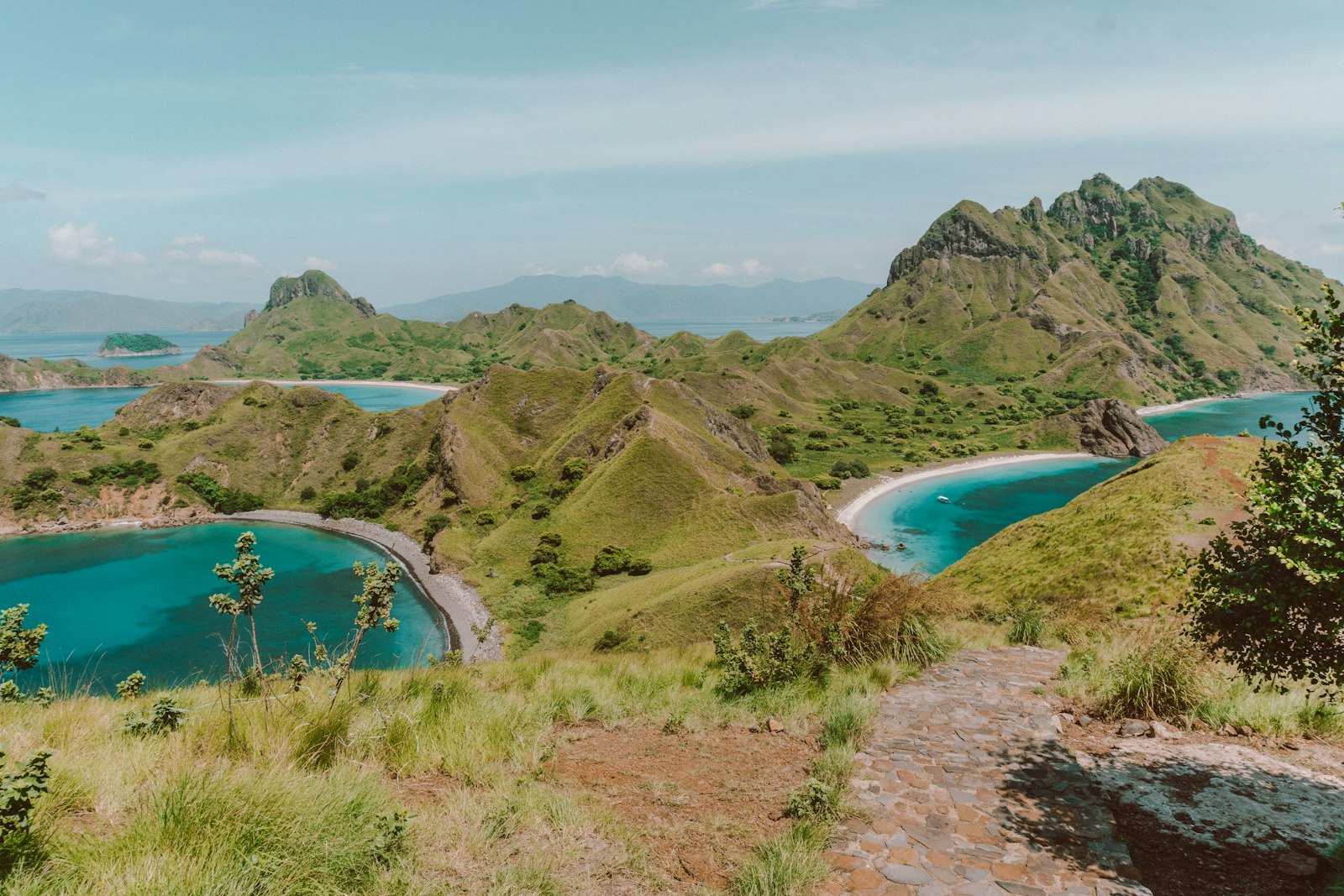
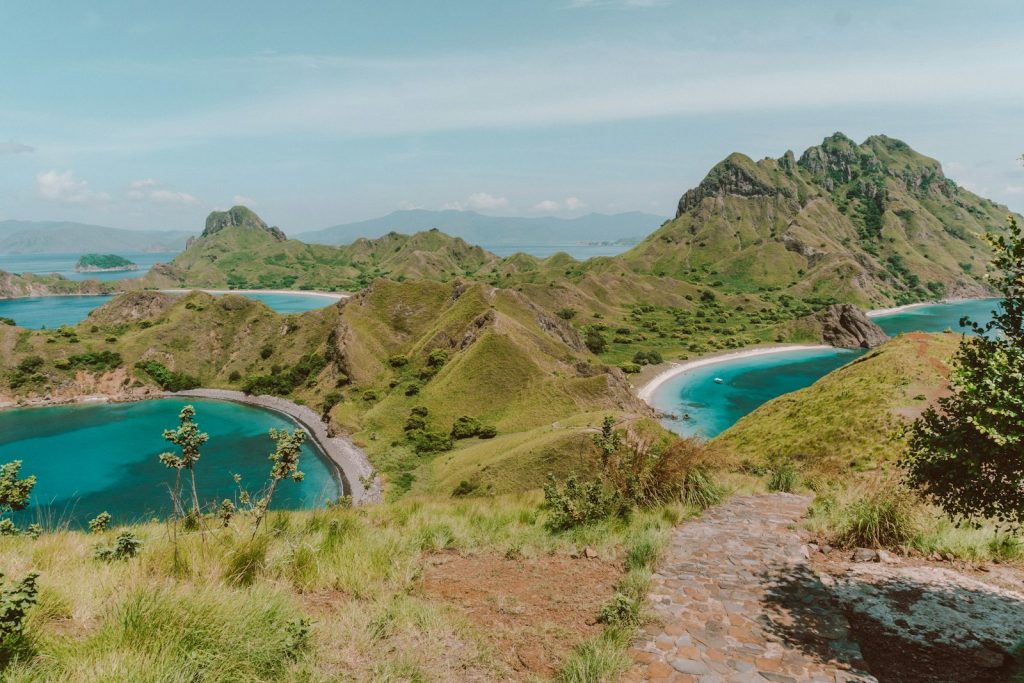
The photograph you have seen a thousand times — the ridge looking down over three bays with beaches of different colors — is taken from the top of Padar Island’s main viewpoint. The hike involves a substantial number of stone steps (operator estimates vary widely; no official count exists), and it is steep but short. Allow twenty to forty minutes up at a comfortable pace. Sunrise is when the eastern light hits the bays directly, which is why virtually every operator schedules departures from Labuan Bajo between 04:00 and 06:00 for this. Early. Cold coffee. Worth it.
Pink Beach
Located on the coast of Komodo Island, the sand gets its blush color from white sand mixed with fragments of red and pink foraminifera — microscopic shelled organisms — along with coral particles. The snorkeling from the beach is decent and accessible without dive certification. What the photos rarely show: it can get busy in peak season with day-trip boats all arriving in the same two-hour window. Private charters have the advantage of timing flexibility — arrive slightly early, leave before the crowd peaks.
Komodo Island and Rinca Island: The Dragons
Both islands have resident Komodo dragons (Varanus komodoensis). Rinca is closer to Labuan Bajo, has a renovated boardwalk visitor area, and tends to be included in shorter trips. Komodo Island is farther but larger, and the treks are longer. On either island, a ranger-led walk is mandatory — luring or feeding the animals is prohibited, and sightings are genuinely likely but never guaranteed. Both islands are within normal day-trip range from Labuan Bajo or from an anchored phinisi.
Manta Point
The main manta aggregation site is Karang Makassar (Makassar Reef) between Komodo and Flores islands. Drift-snorkeling here is one of the most memorable things you can do in the entire archipelago. The current runs strong; basic swimming confidence is required, and some comfort with open-water drift is helpful. Manta sightings depend on season, current, and plankton availability and cannot be guaranteed by any operator, regardless of what they tell you.
Park Fees: What to Know Before You Budget
Komodo National Park entry involves several fees that are frequently bundled into tour and liveaboard packages. No single authoritative English-language government tariff table was available at time of writing, so treat the figures below as the most-commonly-reported structure and confirm the current amounts with your operator or the park office before your trip [VERIFY].
- Entry ticket (foreign visitor)
- Approximately IDR 250,000 per person per day — the most-cited figure; some bundled all-in quotes run IDR 350,000–500,000 per person per day
- Conservation fee
- Approximately IDR 100,000 per person
- Harbour fee
- Approximately IDR 25,000 per person
- Ranger/guide fee
- Approximately IDR 200,000 per group of up to five people for trekking on Komodo or Rinca [non-official source]
- Diving surcharge
- Approximately IDR 25,000 per diver per day [least formally sourced of these figures]
The important practical note: most tour and liveaboard packages advertise a headline price and list park fees as excluded. Always ask your operator for an itemized breakdown of what is and is not included. The proposed 2022 IDR 3.75 million per-person annual membership for Komodo and Padar was officially suspended and is not in force for 2024–2025; any source quoting that figure as current is out of date.
Timing Your Trip: Season Matters More on a Phinisi Than at a Resort
The dry season runs roughly April through October, with the most reliable window from May through September. Seas are calmer, days are clearer, and boat movements are more predictable. April and October are shoulder months — usually fine, occasionally rough.
November through March is wet season. The park does not close, but sea conditions can disrupt crossings and make snorkeling sites choppy or murky. A resort-based honeymoon in wet season is far more viable than a multi-night phinisi charter, since you sleep on land and can reschedule day trips when the sea cooperates. If a phinisi charter in wet season is what you want, discuss itinerary flexibility with your captain in advance — a good crew will have alternatives ready.
For the Bali to Komodo extension planning perspective: if you are setting your wedding date and want to build this trip backward from ideal conditions, May through August is the sweet spot for both centers. Bali in those months is busy but its weather is reliable; Komodo in those months is at its calm-sea best.
A Sample Day-by-Day Sketch
This is one version of how a private-phinisi-focused seven nights might run. Adjust it for your own priorities.
- Day 1 (Bali)
- Arrive international, transfer to villa. Dinner in. Rest.
- Day 2 (Bali)
- Morning spa session (Ubud or Seminyak, depending on your base). Lunch out. Afternoon rice-terrace walk or pool. Private dinner at the villa.
- Day 3 (Bali)
- Free morning for any practical needs — pharmacy, currency, SIM card top-up, any remaining post-wedding admin. Afternoon at leisure. Early dinner, early bed — your flight tomorrow is probably before 08:00.
- Day 4 (Transit + Labuan Bajo)
- Depart DPS early. Arrive LBJ by mid-morning. Transfer to marina. Light lunch. Embark private phinisi by 14:00–15:00. Sail to first anchorage for sunset on deck.
- Day 5 (At sea)
- Pre-dawn departure for Padar Island sunrise hike. Return to boat for breakfast. Sail to Pink Beach — snorkel, swim, picnic lunch on the boat. Afternoon: Komodo Island ranger trek (dragons). Sail to overnight anchorage. Private dinner on deck.
- Day 6 (At sea)
- Morning drift-snorkel at Manta Point (Karang Makassar) — manta sightings possible but not guaranteed. Afternoon: Rinca Island ranger walk as alternative or addition. Return to Labuan Bajo by late afternoon. Check in to resort or town hotel. Dinner ashore.
- Day 7 (Labuan Bajo + Departure)
- Morning at leisure in town — the waterfront has a handful of good coffee spots. Airport transfer for your return flight to Bali or your onward connection. End of trip.
If you have four Komodo nights instead of three, the extra night is best spent at a quiet anchor between Komodo and Flores where you see almost no other boats — ask your captain rather than us. That is their knowledge, not something a planning guide can map reliably.
What This Trip Costs: Honest Ranges
All of the following exclude international flights and assume a couple.
- Bali accommodation (3 nights, mid-to-high end private pool villa): approximately $300–$800 per couple per night depending on area and tier
- Bali spa, meals, transfers: plan $100–$300 per couple per day
- DPS–LBJ return flights: approximately $80–$200 per person each way depending on airline and season [VERIFY current fares]
- Private phinisi charter (2–3 nights): from roughly $4,000 for a two-night charter for a couple on a smaller vessel; $6,000–$10,000+ for three to four nights on a larger or premium boat. All by-quote — peak season rates are higher
- Resort stay in Labuan Bajo (if hybrid): high-end resorts run approximately $350–$800+ per couple per night
- Park fees: usually excluded from package prices; budget roughly IDR 375,000–575,000 per person per day as a working estimate and confirm with your operator
- Meals, tips, incidentals in Labuan Bajo: $50–$150 per couple per day ashore
A realistic all-in budget (excluding international flights) for a couple on the private-phinisi version of this week runs somewhere between $5,000 and $15,000 depending heavily on the phinisi tier, the Bali villa standard, and how much you eat and spa your way through Bali. The wide range is not evasive — it reflects the genuine span of the market.
If that is beyond your current budget, the same week structured as resort-based day trips in Komodo runs considerably less, with more control over what you spend per day. The trade-off is the immersion and the absolute privacy of having the whole boat.
Ready to start building your actual itinerary with someone who knows which boats are available when, which anchorages suit your pace, and what the current park-fee situation is? Use our enquiry form or reach out via WhatsApp to Komodo Luxury at +62 811 3823 875 — they handle the planning logistics and can quote the phinisi charter component properly. As an independent guide, we may receive a referral fee if you proceed through them, at no extra cost to you; it does not change what we write or recommend.
Practical Notes for Couples
Seasickness on a phinisi
I will be blunt about this because some planning sites gloss over it. A phinisi is a wooden sailing vessel, usually between twenty and thirty meters, and it moves with the sea. In calm dry-season conditions the motion is gentle and pleasant. In choppier channels — particularly between islands in the shoulder months — it is a real boat crossing and some people feel it. If either of you has a history of motion sickness, carry meclizine or dimenhydrinate and take it before boarding, not after the crossing has started. The amidships cabin (closest to the center of buoyancy) is the most stable sleeping position.
Health prep
Flores, including the Labuan Bajo area, is dengue-endemic, and malaria risk exists in some rural and eastern parts of the island. This is general information, not medical advice — consult your doctor or a travel clinic before departure for current prophylaxis recommendations and vaccination status [direct to CDC, UK Fit for Travel, or Smartraveller for your nationality]. Long sleeves and DEET-based repellent at dusk are basic common sense regardless.
Medical facilities in Labuan Bajo are improving but remain below Bali and Jakarta in complexity. Serious medical situations typically evacuate to Bali. Carry comprehensive travel insurance with medical evacuation coverage; if you plan to dive, ensure it covers diving.
What to pack specifically for this trip
- Dry bags for electronics on boat transfers and snorkel trips
- Reef-safe sunscreen (some operators require non-oxybenzone formulas — check with yours)
- Rashguard for snorkeling (UV protection and some comfort on deck)
- Non-slip boat shoes or reef sandals
- Light layer for cool nights at anchor
- Rain jacket if traveling outside peak dry season
- Waterproof phone case or small dry pouch
Frequently Asked Questions
How many days in Bali before flying to Komodo is realistic?
Three nights is the practical minimum for most couples arriving on long-haul international flights. It gives you one full recovery day, one proper leisure day, and one morning for any practical needs before your LBJ departure. Four nights is more comfortable and removes almost all flight-delay anxiety from the Komodo portion of your trip.
Can we do this trip in reverse — Komodo first, then Bali?
Logistically, yes — flights work in either direction. Emotionally, most couples find the Bali-first sequence works better because Komodo involves early starts, boat crossings, and higher physical activity levels. Coming off an international flight straight onto a phinisi charter is doable but genuinely tiring. Bali first softens the arrival.
Is a private phinisi really necessary, or will a shared cruise do?
It depends entirely on what you want from the experience. A well-reviewed shared liveaboard with a small group of like-minded travelers can be perfectly enjoyable. On your honeymoon, though, a shared boat means your mornings, meals, and anchorages are set by consensus with strangers. Private charter means the captain works to your pace. The cost difference is significant — roughly two to five times more for private versus shared — but it is a fundamentally different product, not just a more expensive version of the same thing.
What are park fees for Komodo National Park and are they included in packages?
Park fees for foreign visitors are most commonly reported as approximately IDR 250,000 per person per day plus conservation and harbour fees, though the exact current structure should be confirmed directly with your operator or the park office before your trip [VERIFY — no single official English tariff table was available at time of writing]. Tour packages almost universally list park fees as excluded from the headline price, so ask for an itemized breakdown when comparing quotes.
Are manta ray sightings guaranteed at Manta Point?
No. Manta sightings at Karang Makassar depend on current, plankton availability, and conditions on the day. Operators who guarantee sightings are overpromising. What is realistic: this is one of the most productive manta aggregation sites in Indonesia, and the majority of snorkeling visits during good conditions result in at least a brief encounter. Come hoping, not expecting, and the experience tends to exceed expectations.