How to read this: Labuan Bajo Honeymoon is an independent honeymoon planning & curation guide for Labuan Bajo and Komodo National Park (Flores, Indonesia) — we curate romantic stays and private phinisi sailings, then route your enquiry to a vetted partner (Komodo Luxury) who arranges the trip. We are not a resort, cruise operator or booking platform, and resort names are used only as neutral examples, not claims of affiliation or endorsement. Prices are by quote and vary by season, vessel and party; figures here are indicative ranges. Sea conditions, ferry and flight schedules, and park rules change — please verify with the operator and official Komodo National Park sources before you travel. This is general information, not advice or a binding offer. We may earn a referral fee at no extra cost to you, and it never changes what we publish.
A 4D3N Komodo honeymoon resort phinisi combo is a four-day, three-night trip structure that divides your stay between a resort base in Labuan Bajo and one or two nights aboard a private phinisi sailing through Komodo National Park. You get a real bed in a real hotel for your arrival night and your final night, and the boat delivers the wild stuff in the middle: a Padar Island sunrise, a Pink Beach snorkel, a manta drift, a dragon walk, and a flying-fox sunset, all without strangers sharing the deck. It is the most common format couples settle on when they want both comfort and immersion but cannot — or do not want to — commit to a full liveaboard trip.
What this guide does is lay that arc out honestly: what the logistics actually look like, where the tradeoffs live, and what to think about before you commit. The hybrid is genuinely good. It is also more complicated than either a pure resort trip or a pure liveaboard, and couples who are not prepared for the packing-and-transfer piece sometimes find the seams more jarring than they expected. Both of those things can be true simultaneously.
The Core Idea: Why a Split Stay Makes Sense for Four Days
Four days is a short canvas for Komodo National Park. On a straight resort itinerary with day trips, you are waking up before dawn for every excursion, commuting to the park by boat each morning, and returning to town each evening. That format is fine for efficiency. It is not fine for feeling like you actually arrived at the place you flew across the world to reach. The islands look different from the water at dusk. You cannot get that from a resort room.
A full liveaboard for four days, on the other hand, means three nights on the boat. For couples who genuinely love being at sea, that is a gift. For couples who are unsure about motion, snoring generators, or the reality that a phinisi bathroom is functional rather than luxurious, three nights is a long commitment to make without prior experience on one.
The split stay resolves both problems partly. You arrive to a proper hotel room, recover from travel, sleep well. The boat segment gives you one or two nights of the real experience — anchored off islands, stars overhead, crew who know the park. Then you return to the resort for a final, unhurried night before your flight home. It is not perfect in either direction; it is a considered compromise that gives you more than either extreme in isolation, for four days specifically.
Getting There: Arrival at Komodo Airport (LBJ)
Labuan Bajo is served by Komodo International Airport, IATA code LBJ, at the western tip of Flores Island in East Nusa Tenggara province. The airport sits roughly two kilometres from the town centre — a five-to-fifteen minute drive. Transfer by taxi typically runs around IDR 50,000–70,000, though that is a commonly reported range, not an official fixed tariff. Most resorts offer shuttle pickup if you arrange it in advance, which is the better option on an arrival day when you are tired and carrying luggage.
From Bali (Ngurah Rai, DPS), the flight takes approximately one hour and ten to twenty minutes in the air. Garuda Indonesia and Indonesia AirAsia are the two most established operators on the DPS–LBJ route; Citilink, Batik Air, Lion Air, Wings Air, and TransNusa have all served it at various points. Schedule and frequency change by season — roughly four to six daily departures each direction in low season, eight to ten or more at peak — so check current timetables when you book. Direct flights also exist from Jakarta (CGK) and Surabaya (SUB).
For a 4D3N trip, arrival timing is critical. A morning departure from Bali gets you to LBJ by midday or early afternoon, which leaves a full arrival afternoon. An evening arrival loses you an entire day that you do not have to spare. If you cannot avoid landing after 15:00, add a buffer night to the resort end of the trip so the itinerary does not start under pressure.
The Four-Day Arc: Day by Day
What follows is a representative template. Sea conditions, park rules, operator schedules, and tidal timing all affect the actual sequence. Your operator will build the real plan based on conditions at the time of your trip. This arc is a planning foundation, not a contract.
Day 1 — Arrival: Resort Night, Town Walk, Early Night
Arrive LBJ. Transfer to your resort. Do nothing ambitious.
That sounds like wasted advice, but arrival day in Labuan Bajo has a way of surprising couples who arrive from long international journeys via Bali and immediately try to make it count. The waterfront strip is compact and easy to walk — local warungs, a few proper restaurants, the marina with boats loading for the morning. A dusk stroll along the harbour and a quiet dinner is all you need. Tomorrow starts early.
If you are staying at a property like AYANA Komodo (at Waecicu Beach, which has a private boardwalk and jetty) or Ta’aktana, a Luxury Collection Resort & Spa (at Pantai Wae Rana, opened 2024), those resort facilities — pools, spa, sunset decks — give you a very pleasant arrival evening without leaving the property. Other properties [VERIFY names before finalising], including Plataran Komodo Resort & Spa and Sudamala Resort Seraya, are also frequently cited in this market segment; confirm operating status and availability directly.
Practical note on packing for the split stay: this is the right evening to sort your luggage. Most resorts will store large bags while you are on the boat. Pack a separate, smaller overnight bag for the phinisi segment — clothes for one or two nights, a dry bag for electronics, swimwear, reef-safe sunscreen, and motion-sickness medication if either of you uses it. Boat cabins have limited storage. Anything you do not need on the water stays at the resort.
Day 2 — Embarkation: Board the Phinisi and Head Out
Embarkation times vary by operator and route. Many private charters depart the Labuan Bajo marina mid-morning, once provisions are loaded and the crew has received conditions briefings from the harbour authority. Some operators run a late-afternoon departure for a shorter overnight, arriving near Padar in time for the next morning’s sunrise. [VERIFY exact embarkation times with your operator — this varies by vessel and itinerary, and the time stated in marketing materials is not always the operational time.]
What the embarkation experience actually feels like: you arrive at the marina with your overnight bag, walk a dock, and board a wooden-hulled vessel that may be anywhere from twelve to thirty metres long. The crew handles your bag, shows you the cabin, and points out where everything is. Then the boat motors out of the harbour, passes the small islands that ring the bay, and starts heading south-southeast toward the national park boundary. The sea is usually flat near the harbour; it gets livelier as you cross into open water. This is when seasickness either arrives or it does not — which is why medication taken the evening before (not the morning of) is strongly advisable for anyone with any doubt.
The day-two plan depends on whether you are doing a one-night or two-night cruise segment. The next section covers both options.
Day 3 — The Island Ring: Padar, Pink Beach, Mantas, Dragons, Kalong
This is the centrepiece day. Most private phinisi itineraries try to cover the main circuit in one full day if you are on a one-night cruise, or spread it across two days if you have the extra night. Both are achievable; two days is more comfortable and less rushed.
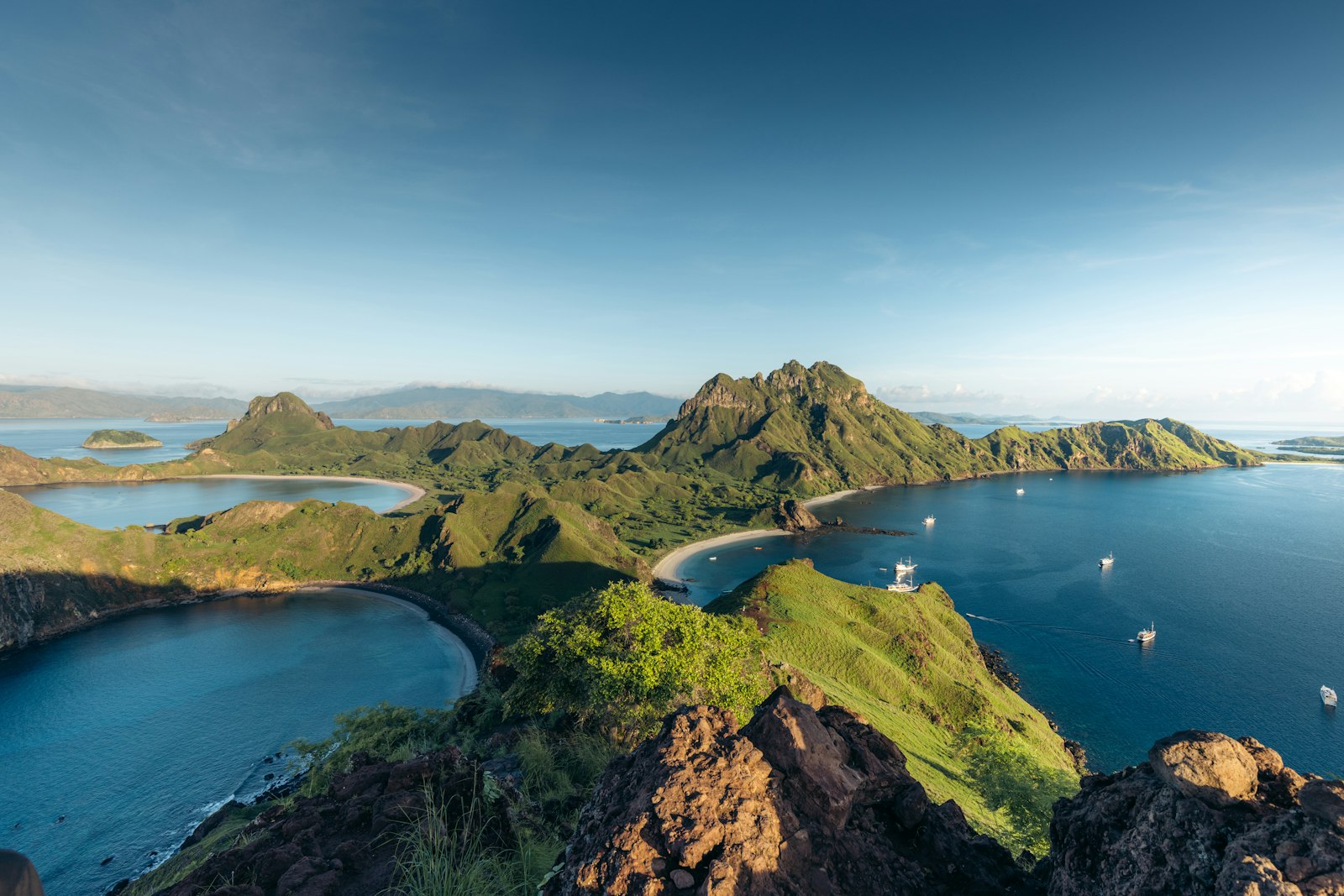
Padar Island Sunrise
Boats position overnight to anchor near Padar so that the tender can land guests at the base of the climb before first light. Departure from the main anchorage is typically between 05:00 and 06:00; [VERIFY with your operator]. The hike to the viewpoint follows a series of constructed steps up a steep hillside. A commonly circulated figure of “700+ steps” is not an official park measurement and should be treated accordingly — the accurate information is that the ascent takes most couples between twenty and forty minutes at a moderate pace, and it is steeper than it looks in photographs. Proper shoes with grip are non-negotiable; flip-flops are a bad idea and some rangers will not allow them on the trail.
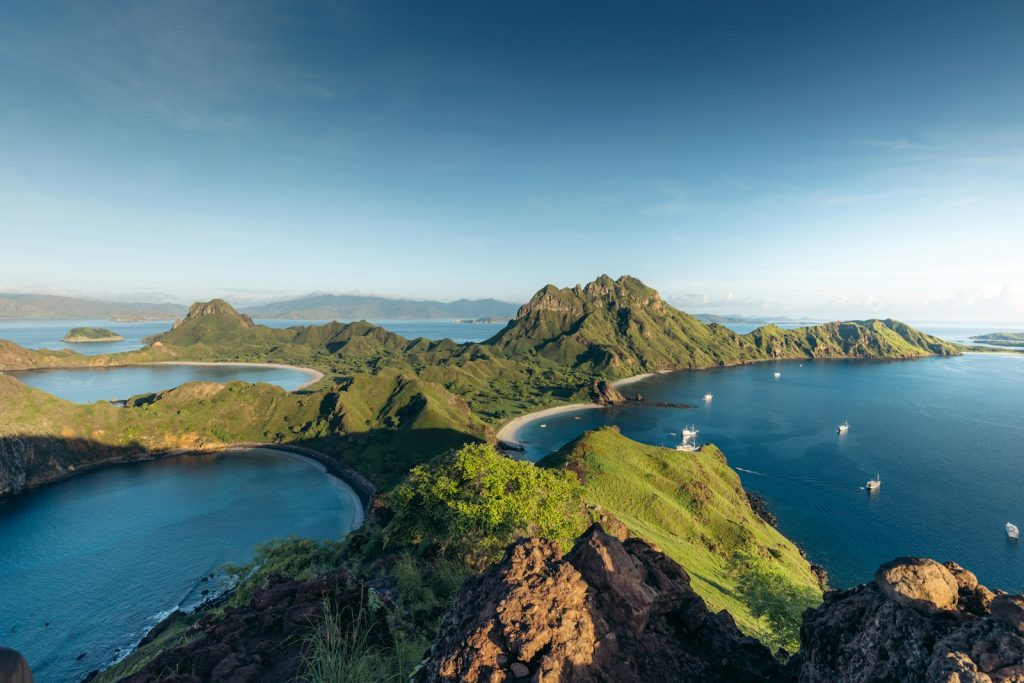
The payoff is a ridgeline viewpoint overlooking three distinct bays, each with its own hue, fanning out below you as the sky turns from dark blue to rose to gold. That view, at that light, is why virtually every Komodo phinisi itinerary is built around it. It is not hype. It is also not a guarantee: cloud cover, especially in shoulder season, can obscure the light at exactly the wrong moment. This is the Komodo archipelago, not a studio set.
Pink Beach (Pantai Merah) Snorkel
After Padar, the standard move is Pink Beach on Komodo Island. The colour is real and explainable: the white sand base is mixed with fragments of foraminifera, tiny calcified marine organisms with red and pink shells that accumulate over centuries alongside broken coral. At midday the beach reads as pale rose; in early morning or late afternoon light it pulls more toward terracotta. Either way, it is a genuinely distinct-looking place.
Snorkelling off the beach suits both beginners and experienced swimmers. The reef is close to shore. Current can run through in sections near the point; stay within range of your guide and do not drift away from the group. If you have brought your own sunscreen, check that it is oxybenzone-free and octinoxate-free — some operators require reef-safe formulations, and it is the right choice regardless.
Manta Point (Karang Makassar) Drift Snorkel
Manta Point — more precisely the aggregation and cleaning sites around Karang Makassar, or Makassar Reef, in the waters between Komodo Island and the Flores coast — is a drift snorkel in genuine open-water conditions. The current here is real and strong. You enter upstream and let the water carry you along the reef edge; the boat follows from the surface. When mantas are present, they circle the cleaning station below or pass on feeding approaches, sometimes at arm’s length in clear water.
Mantas are not guaranteed. They are wild animals responding to tidal cycles, water temperature, and plankton concentrations that neither you nor your operator controls. Sightings are common in dry-season conditions (roughly May through October) but cannot be promised by any honest operator. The drift itself is excellent even on days when mantas are absent or briefly glimpsed — the reef, the current, and the open water are worth the entry regardless. A basic comfort level in open water is necessary; if either of you is uncertain in current, discuss this with your operator before the day begins.
Komodo or Rinca Island Dragon Walk
Both Komodo Island and Rinca Island host populations of Komodo dragons (Varanus komodoensis), the world’s largest living lizard. A guided ranger walk is mandatory on both; you cannot walk independently, and the rule exists for your safety, not as bureaucratic inconvenience. Dragons are apex predators and behave accordingly. Sightings are highly likely — the animals are numerous and tend to move near ranger stations — but not guaranteed, and any operator who guarantees them is overpromising. Luring and feeding are prohibited and damaging to the animals’ behaviour.
- Komodo Island
- Farther from Labuan Bajo, typically two to three hours by boat depending on vessel speed. Multiple trek lengths available from short loops to longer interior walks. Often paired with Pink Beach in the same day. The island feels larger and less managed than Rinca; the approach has more of the quality of actually being somewhere remote.
- Rinca Island
- Closer to Labuan Bajo, roughly one to one and a half hours. The visitor boardwalk area near the ranger station was renovated in recent years. Dragon sightings are reliable near the station. Good option when a full Komodo Island crossing would make an already long day unmanageable, or when the sea conditions make the longer run impractical.
On a one-night cruise, fitting both Pink Beach, Manta Point, and Komodo Island in a single day is possible but makes for a long, fast-moving day that some couples find tiring rather than romantic. Rinca is the more realistic choice when time is tight.
Kalong Island Flying-Fox Sunset
Kalong Island, near the mouth of Sape Strait, is home to a large colony of flying foxes — fruit bats with wingspans that can exceed a metre. At dusk, thousands of them lift off the mangroves simultaneously and stream across the sky in long, irregular columns. Watching from the boat deck as the sun drops and the bats fill the air above you is one of the genuinely unrepeatable moments that Komodo throws at you without warning. It is loud, a little chaotic, and impossible to fully photograph. Most operators include this as a late-afternoon anchor point before heading back toward Labuan Bajo or the overnight mooring.
Day 4 — Return to Resort: Final Night, Slow Morning, Departure
Disembarkation on the morning of Day 4 returns you to the Labuan Bajo marina, where your resort will typically hold your large luggage. The return is usually a half-morning crossing, arriving in town by mid-morning. From there you transfer back to the resort, shower properly, and have an actual bed again.
The final resort night is not the least important element of this itinerary — it is often the one that couples remember most clearly, for the simple reason that it is the first time they can decompress after two days of early starts, boat motion, and the sensory noise of the national park. A spa treatment, a good dinner, and a long sleep matter here. Book the couples spa session in advance if that is on your list; availability at the better properties gets thin in peak season.
Departure day is morning of Day 5 (your travel day home). If your flight to Bali departs in the early afternoon, you have the morning to sit over breakfast, walk the harbour one more time, or do nothing at all. The airport is five to fifteen minutes from town. LBJ is a compact facility that processes departures quickly but has limited seating, so arrive forty-five minutes to an hour ahead of your domestic flight check-in time.
One Night vs. Two Nights on the Phinisi: What Actually Changes
The choice between a one-night and two-night cruise segment is the central planning decision in a 4D3N resort phinisi combo, and it is worth thinking through rather than defaulting to whatever the operator recommends first.
One-Night Cruise (Embark Day 2 PM, Disembark Day 3 PM)
A single night on the boat means you are asking the itinerary to cover Padar, Pink Beach, Manta Point, and a dragon island in one active day, starting before dawn and finishing at dusk. It is achievable. It is also a long day, and whether it feels like an adventure or an endurance test depends significantly on how enthusiastic both of you are about an unbroken nine-to-ten-hour activity schedule.
The advantage is that the boat segment remains short enough that seasickness risk is contained to one night’s crossing, and couples who are genuinely uncertain about how they will handle a phinisi cabin can treat it as a trial. If you discover you love it, the next trip is longer. If you discover the boat is not for you, you lose one night rather than two.
Two-Night Cruise (Embark Day 2 AM or PM, Disembark Day 4 AM)
Two nights at sea distributes the island circuit across two days. Padar and Pink Beach on Day 2, Manta Point and the dragon walk plus Kalong sunset on Day 3. The pacing is materially different: you have time for a lazy hour at anchor between sites, a proper lunch without watching the clock, a morning swim off the back platform before the day-trip boats arrive at the same location. The gap between “active holiday” and “romantic holiday” closes significantly with that extra day.
The tradeoff is that you are spending two nights in a boat cabin. The better private phinisi on this circuit are genuinely comfortable — proper beds, air conditioning in the cabin, ensuite or semi-private bathrooms — but they are compact by any hotel standard. Tall travellers hit their heads. Storage is limited. The generator runs in the evening and stops at some point in the night. If either of you is prone to motion sickness, two nights means two nights of exposure rather than one. None of this is a dealbreaker, but it is information to weigh honestly.
The Logistics of Splitting: Packing, Transfers, and What Actually Gets Inconvenient
The clearest downside of the resort-phinisi combo is also the most underappreciated: you pack twice. You move from resort to boat and back, which means decisions about what goes in the overnight bag versus what stays in storage. On a longer trip, this overhead becomes trivial. On a four-day honeymoon, it surfaces on the exact morning when you are also trying to embark on a boat and catch the dawn light on Padar the next day.
The practical approach: keep the phinisi bag small enough that you would not mind carrying it for ten minutes if you had to. Everything you do not genuinely need on the water stays in a labelled bag at the resort. Most properties in Labuan Bajo are accustomed to this arrangement and handle it without difficulty — confirm with your specific property when you book, and ask where exactly you collect your stored luggage on return, because “front desk” at 07:00 is a different answer from “bell desk open 24 hours.”
Transfer timing between resort and marina is short — the town is compact — but it is still a variable. If your embarkation is scheduled for 09:00 and your resort checkout is 11:00, clarify whether early luggage storage is available. Most resorts accommodate it without charge for guests with confirmed later returns; confirm rather than assume.
Early departures are real. Boats heading toward Padar for sunrise typically leave the marina at 06:00 to 07:00 [VERIFY exact time with your operator], which means a 05:00 to 05:30 wakeup on the day of the sunrise hike. Weather reschedules happen. Operators do not cancel a Padar sunrise lightly, but a sudden deterioration in sea conditions overnight can push the entire plan to a different time or a different day. On a split-stay itinerary with a fixed return to resort scheduled, a weather delay can cause more scheduling friction than it does on a pure liveaboard where the boat simply waits for conditions to improve. Discuss the contingency plan with your operator before you board: what happens if Manta Point is uncrossable, or if Padar is fogged in?
Cost Ranges: What to Budget for a 4D3N Hybrid Komodo Honeymoon
All figures below are approximate market ranges. Actual pricing is by quote, varies by operator, vessel quality, and season, and these numbers should not be treated as fixed rates. Peak season (July–August) runs higher across the board. International flights are excluded.
| Component | Approximate Range (USD, per couple) | Notes |
|---|---|---|
| Resort: 2 nights (arrival + final) | ~$350–$1,300+ total | Mid-tier ~$175–$300/night; high-end (AYANA, Ta’aktana) from ~$350–$665+/night [VERIFY current rates] |
| Private phinisi: 1-night cruise | From ~$2,000–$3,000+ | Comfortable vessels; premium boats run higher; by-quote only |
| Private phinisi: 2-night cruise | From ~$4,000; premium $6,000–$10,000+ | Full-boat charter; includes crew, meals, fuel in most cases; confirm inclusions |
| Komodo National Park fees | ~$15–$30+ per person per day | Most-reported foreign structure: entry ~IDR 250,000/person/day + conservation ~IDR 100,000 + harbour fee ~IDR 25,000; ranger fee ~IDR 200,000/group [VERIFY — no official tariff table; confirm with operator] |
| Spa / private dinner add-ons | $100–$400+ per session/setup | Spa sessions at resort properties; private deck dinners or sandbar setups via operator (tide- and park-rule-dependent) |
| Airport transfers, meals not covered | $20–$100+/day | Town restaurants at all levels; resort dining priced separately |
A few things worth flagging explicitly on costs: park fees are frequently excluded from the headline price on liveaboard and charter packages. Ask your operator for a line-item breakdown before you pay a deposit — “park fees included” and “park fees excluded” represent a meaningful difference across a two-day visit to multiple sites. The 2022 proposal to charge foreign visitors IDR 3,750,000 per person as an annual conservation membership was protested, suspended after an operator strike, and subsequently cancelled. It is not in force as of 2024–2025; if you encounter a source still citing that figure as current, it is outdated.
Ready to get actual quotes rather than ranges? Use our enquiry form and we can connect you with our vetted concierge partner. Mention your preferred dates, whether you want a one- or two-night cruise, and any motion-sickness history — those details change the recommendation significantly. You can also reach Komodo Luxury directly on WhatsApp: +62 811 382 3875, or by email at sales@komodoluxury.com. Full disclosure: if you proceed with them through our recommendation, they may pay us a referral fee at no extra cost to you. No one can pay to change what we publish here.
Wildlife Honesty: What to Expect and Not Expect
The Komodo archipelago delivers genuinely extraordinary wildlife encounters. It also delivers them on wildlife terms, not on honeymoon-package terms. That distinction is worth stating plainly before you spend real money and real holiday time on this trip.
Komodo dragons: sightings are highly likely at both Komodo Island and Rinca Island. The animals are numerous, move throughout the day, and tend to be active near the ranger stations where visitors walk. A well-managed ranger walk almost always produces at least one good sighting. Almost always is not always. Sightings vary by season, time of day, weather, and the dragons’ own unpredictable movement patterns. The experience is more controlled than a full safari and less scripted than a zoo; plan for something in that range and you will not be disappointed.
Manta rays: condition-dependent, current-dependent, and never guaranteed. Dry season (May–October) produces the most consistent reports from operators, but no month is a guarantee. The cleaning station at Karang Makassar is a real place with real animal behaviour; the uncertainty is not manufactured caution, it is the honest description of how wildlife works. Manage expectations and you will still have a remarkable snorkel regardless of manta count.
Marine life generally: snorkelling off Pink Beach and at various anchorage points around the park is excellent by most standards. The reefs have their own pressures — some areas show bleaching; anchor damage is a documented concern near popular sites — but the overall underwater experience remains one of the better in eastern Indonesia. Reef-safe practices matter here more than in most places.
Is This Itinerary Right for You? An Honest Assessment
The 4D3N resort plus phinisi split is a strong format under specific conditions. It is not for everyone, and understanding where it is a bad fit will save you from a trip that felt like work.
It works well if: you are pairing Komodo with Bali as a two-centre honeymoon and cannot take more than four days in the east; you want the private-boat experience without the full commitment of three nights aboard; you or your partner have some seasickness sensitivity and prefer limiting boat nights to one or two; you want resort spa access on both ends of the trip; you enjoy a faster-paced, experience-dense trip rather than a slow, restful one.
It is a weaker fit if: slow mornings and no alarm clocks are your honeymoon definition; you are heavily seasick-prone (the crossings are real and the boat nights are non-trivial); your priority is underwater time rather than island variety (a pure liveaboard with a skilled dive operator is better for that); or you want maximum flexibility to linger at sites without a resort-return deadline shaping the schedule.
The most common regret I hear from couples who chose this format is not that they did it — it is that they rushed the boat segment because they only took one night instead of two. If four days is what you have and you want the hybrid, spending both middle nights on the phinisi and using the resort only for arrival and final night is almost always the better call.
Best Time of Year for the Resort + Phinisi Combo
The dry season — roughly April through October, with May through September as the most stable window — is the right time for this itinerary. Calm seas reduce the seasickness variable, visibility underwater is at its best, and weather-driven reschedules are less common. This matters particularly on a four-day trip where there is limited slack to absorb a disrupted day.
July and August are peak season: higher prices for both resorts and private charters, more competition for vessel bookings, and more day-trip traffic at popular sites. The park is still less crowded than Bali’s tourist zones, but it is perceptibly busier than April or September. If your honeymoon dates are flexible, May, June, and September offer good weather reliability at a slight reduction in demand and pricing pressure.
The wet season (November through March) brings rougher and less predictable sea conditions. Komodo National Park does not close seasonally, but operators may adjust or significantly reroute itineraries based on sea state. On a short hybrid trip that depends on crossing open water between resort and park, a wet-season itinerary carries more weather risk than on a longer liveaboard where the boat can wait. Discuss this explicitly with your operator if your only available dates fall in this window.
Manta sightings are reported at Karang Makassar year-round, though quality varies by conditions. Some operators mention the plankton-rich months around December through February as potentially productive manta periods despite rougher seas overall; that claim is not firmly established in publicly documented sources and should be treated as an informed suggestion rather than a confirmed seasonal pattern [VERIFY with operator at time of booking].
A Word on Honeymoon Extras
The standard private-phinisi honeymoon package often includes some combination of: a decorated cabin for arrival; a bottle of something cold and sparkling; a private dinner on the boat deck at anchor; and occasionally a sunrise private picnic at Padar before the day boats arrive. These touches are real and they are available. They are also operator-specific and need to be confirmed in writing rather than assumed from the marketing language.
Sandbar dinners — a private table set up on a tidal sandbar as the sun drops — are real and genuinely memorable when they happen. They are also tide-dependent, weather-dependent, and subject to park management rules that can restrict access to specific beaches or sandbars without advance notice. Treat them as a high-probability bonus rather than a scheduled certainty. Ask your operator directly: “Has this been permitted and logistically done at your specific anchorage in the last month? What happens if access is restricted on our date?” The answer will tell you whether it is a real offering or a marketing photo.
At the resort end, couples spa sessions, private candlelit dinners, and flower-petal room setups are available at the properties that market themselves as honeymoon-capable. Book these in advance — not as an afterthought on arrival day. A good resort team needs at least twenty-four hours to arrange the logistics well; forty-eight is better for anything involving a private dinner setup.
Packing for the Hybrid: What to Put in the Boat Bag
This is practical information rather than a comprehensive list. For one or two nights on a private phinisi following a resort arrival:
- Footwear: closed-toe shoes with grip for the Padar hike and dragon walks (sandals and flip-flops are inappropriate and may be refused by rangers); water shoes or old trainers for boarding the tender and walking wet boat decks
- Sun protection: high-SPF reef-safe sunscreen (oxybenzone-free, octinoxate-free), rashguard or UV-protective swim top, wide-brim hat, polarised sunglasses
- Seasickness: meclizine or dimenhydrinate if either of you has any sensitivity to motion; take the evening before your first crossing, not the morning of; the amidships cabin on a phinisi moves least
- Dry bag: one per person for phone, camera, wallet, and any electronics that cannot get wet during snorkel entries or rain squalls
- Clothing: two nights worth of lightweight layers; boat decks are cool at dawn and can be cold at anchor at night in the dry season; a windproof shell earns its space
- Toiletries: reef-safe choices matter more here than at the resort; the national park has limited waste-management infrastructure and what goes into the water at Pink Beach stays there
- Hydration: a refillable bottle; most operators supply drinking water but minimising single-use plastic in the park is worth the small effort
A general health note, not medical advice: Flores is dengue-endemic, and some rural areas of eastern Indonesia carry malaria risk. The Labuan Bajo waterfront is urbanised and coastal, reducing but not eliminating exposure. Consult a travel clinic or your GP four to six weeks before departure, and check current guidance from the CDC, UK Fit for Travel, or Smartraveller for your country. Serious medical care above clinic level in Labuan Bajo requires evacuation to Bali or Jakarta; travel insurance with medical evacuation cover is worth having in this region.
Planning Your 4D3N Komodo Honeymoon
Start the booking process three to four months before your travel date if you are targeting May through September. Private phinisi charters in the right size and quality range for a honeymoon couple book out early in peak season, and the properties most suited to a romantic context do not have unlimited availability. A specific vessel request — one with air-conditioned cabins, an ensuite bathroom, and a sundeck large enough to actually sit on — narrows your options compared to open-market bookings, which is exactly why advance planning matters.
The hybrid itinerary also requires coordinating two bookings — resort and charter — with dates that interlock correctly around embarkation and disembarkation times. Doing that coordination yourself across two separate suppliers is possible; having a single concierge manage both is less likely to produce a gap or an overlap that costs you a night. Start with our enquiry form with your dates, your preferred split (one-night or two-night cruise), and a note on any seasickness history or mobility considerations. We will connect you with the operator best suited to your specific request.
Frequently Asked Questions
What is a 4D3N Komodo resort phinisi combo honeymoon?
It is a four-day, three-night honeymoon structure that splits your stay between a resort in Labuan Bajo and a private phinisi charter in Komodo National Park. You stay at the resort on your arrival night and final night, and you spend one or two nights aboard the boat visiting the main islands. The format gives you a comfortable bed and spa access on both ends of the trip, with the privacy and immersion of a private boat in the middle.
Is one night or two nights on the phinisi better for a four-day honeymoon?
Two nights is almost always the better choice if your schedule allows it. One night forces the entire island circuit — Padar, Pink Beach, Manta Point, a dragon walk, and Kalong sunset — into a single long day, which is achievable but rushed. Two nights distributes those experiences across two days at a pace that actually feels like a honeymoon rather than a highlight reel. The tradeoff is two nights in a boat cabin instead of one; if seasickness is a concern, one night is the more cautious approach.
Are Komodo National Park entrance fees included in phinisi charter packages?
Frequently not. The most commonly reported fee structure for foreign visitors includes an entry ticket of approximately IDR 250,000 per person per day, a conservation fee of approximately IDR 100,000, and a harbour administrative fee of approximately IDR 25,000 per person. Ranger fees for dragon walks on Komodo or Rinca are additional. Always ask your operator for a line-item breakdown before paying a deposit — confirm what is and is not included. These are the figures most widely reported from non-official sources; for authoritative current rates, confirm with your operator or the park office directly [VERIFY]. The 2022 IDR 3,750,000 per-person annual fee was cancelled and is not in force.
How early do boats leave for the Padar sunrise?
Most private charters position overnight to anchor near Padar and land guests at the base of the hike before first light, with tender departures typically between 05:00 and 06:00 to reach the summit for sunrise. The hike itself takes twenty to forty minutes at a moderate pace. Exact embarkation and wake-up times depend on the specific vessel, the distance of the overnight anchorage from Padar’s landing point, and seasonal sunrise timing. Verify the operational departure time with your operator — marketing materials and actual operational schedules sometimes differ.
What should we do if one of us gets seasick on the phinisi?
Bring medication — meclizine or dimenhydrinate are commonly used by travellers in this region — and take it the evening before your first crossing, not the morning of when you may already feel unwell. On the boat itself, the amidships cabin (midship, lower deck) moves least in a swell; request this when booking if motion sickness is a concern. Fresh air and horizon-focus help; lying flat in a sealed cabin below deck in rough conditions typically makes things worse. On a private charter, the crew can slow the boat or change course if conditions become genuinely difficult. If either of you has a significant history of seasickness, have an honest conversation with your operator about which route and which vessel minimises the exposure — some phinisi are more stable than others and some itinerary segments are rougher than others.